By Rod Trujillo | Trujillo Commercial Real Estate Group
You’ve found the perfect commercial space.
The location works. The rent is within budget. The layout makes sense for your business.
You’ve negotiated the major terms, and the landlord sends over the lease.
Then you open the document.
Thirty pages. Maybe forty. Sometimes more.
You recognize the rent amount, the security deposit, and the lease term.
Everything else?
A lot of legal language.
And after reviewing a few pages, it’s tempting to think:
“I’m sure it’s pretty standard.”
But here’s something I want every business owner to understand:
Just because a provision is common in commercial leases doesn’t mean it’s automatically favorable to you.
Commercial leases can contain financial obligations, operating restrictions, and legal responsibilities that extend well beyond the monthly rent.
And unlike many residential leasing situations, commercial lease terms can vary substantially from one property to another.
Before signing, there are five categories of lease provisions I encourage business owners to pay particular attention to.
1. Operating Expenses: What Are You Actually Paying For?
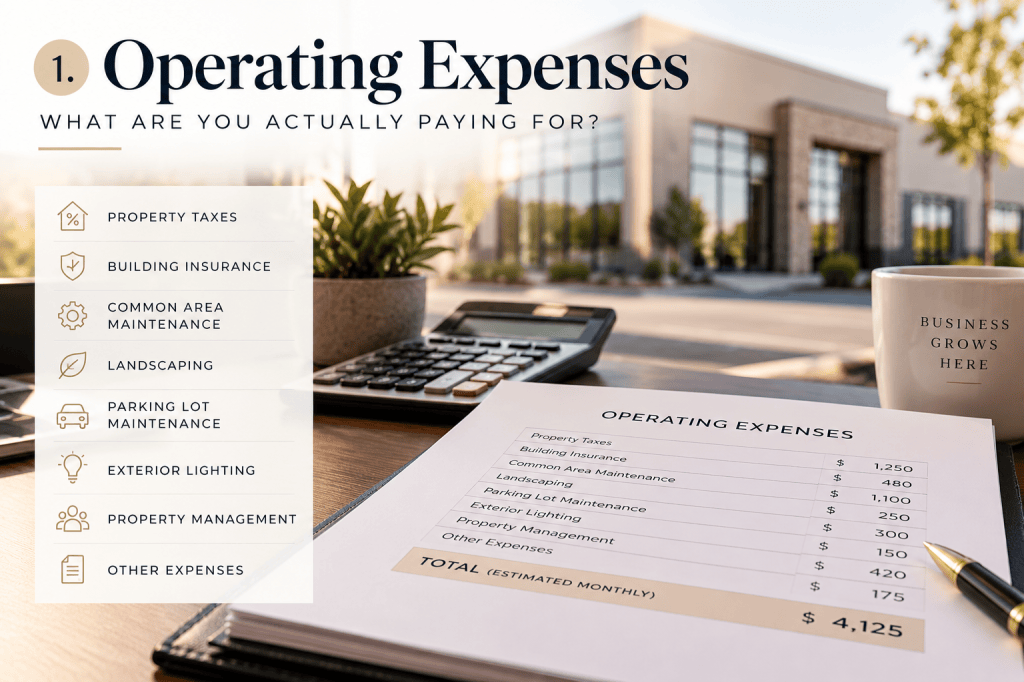
One of the first things I want to understand when evaluating a commercial lease is how operating expenses are handled.
You might see a property advertised at:
$2.50 per square foot, per month.
For a 2,000-square-foot space, that equals:
$5,000 per month in base rent.
But that may not be the full amount you’ll pay.
Depending on the lease structure, tenants may also be responsible for certain property operating expenses.
These can include:
- Property taxes
- Building insurance
- Common area maintenance
- Landscaping
- Parking lot maintenance
- Exterior lighting
- Property management
- Other expenses permitted under the lease
In a Triple Net (NNN) lease, tenants typically pay base rent plus their allocated share of specified property expenses.
But not every NNN lease is structured identically.
Let’s Run the Numbers
Imagine you’re leasing 2,000 square feet.
Your base rent is:
$2.50/SF/month
Estimated NNN expenses are:
$0.85/SF/month
Your monthly occupancy calculation becomes:
| Expense | Monthly Cost |
|---|---|
| Base Rent | $5,000 |
| Estimated NNN Expenses | $1,700 |
| Total | $6,700 |
That’s a difference of:
$1,700 per month.
Or:
$20,400 per year.
And those estimated operating expenses may change over time.
What Should You Look For?
Before signing, understand:
Which expenses can the landlord pass through to you?
How is your proportionate share calculated?
Are there annual reconciliations?
Can operating expenses increase?
Are there exclusions, caps, or limitations?
How are capital improvements handled?
Do you have any rights to review or audit the charges?
For some businesses, operating expenses can represent a substantial portion of the total occupancy cost.
Don’t compare commercial spaces using base rent alone.
Compare what the business is actually expected to pay.
2. Maintenance and Repairs: Who Fixes What?

Imagine you’ve been operating in your new commercial space for six months.
Everything is going well.
Then the air conditioning stops working.
You call the landlord.
And the landlord tells you:
“That’s your responsibility.”
You assumed the landlord handled the HVAC system.
The landlord assumed you understood the lease.
Now you’re looking at an unexpected repair expense.
This is why maintenance and repair provisions deserve serious attention.
Not Every Commercial Lease Assigns Responsibilities the Same Way
Depending on the agreement, tenants may be responsible for maintaining or repairing certain portions of the premises.
Potential responsibilities include:
- HVAC systems
- Plumbing
- Electrical systems
- Interior improvements
- Glass and storefronts
- Doors and hardware
- Equipment serving the premises
- Certain exterior components
- Damage caused by the tenant or its operations
Other responsibilities may remain with the landlord.
The division depends on the lease.
The Difference Between Maintenance and Replacement
This is an especially important distinction.
Routine HVAC maintenance is one thing.
Replacing an entire HVAC unit is something else.
A business owner should understand whether the lease requires them to:
Maintain the equipment.
Repair the equipment.
Replace the equipment.
Or contribute toward replacement costs.
Those obligations can have very different financial consequences.
Questions Worth Asking
Who is responsible for the roof?
Who maintains the HVAC system?
Who pays if major equipment fails?
Who maintains the parking lot?
Who handles exterior lighting?
What happens if a major repair interrupts business operations?
Are there any warranties or service contracts?
What condition must the property be returned in when the lease ends?
A space with attractive rent can become much more expensive when unexpected repair responsibilities are factored in.
The goal is to understand those responsibilities before they become an issue.
3. Personal Guarantees: Is Your Business the Only Party Responsible?

This is one of the most important lease provisions for business owners to understand.
Suppose you operate your business through an LLC or corporation.
You might assume that signing a commercial lease under the company name means the company is the only party responsible for the lease obligations.
Not necessarily.
A landlord may require a personal guarantee.
A personal guarantee is a separate contractual commitment under which an individual agrees to be responsible for certain obligations of the tenant.
Depending on its wording, it can expose the guarantor to significant personal financial liability.
Here’s Why It Matters
Imagine a business signs a five-year lease.
Two years later, the business closes.
There are still three years remaining on the lease.
Depending on the lease, guarantee, applicable law, and the landlord’s ability to mitigate damages, the landlord may have claims arising from the remaining obligations.
If the owner signed a broad personal guarantee, the owner may face personal exposure in addition to the company’s obligations.
That’s why this provision deserves careful review.
Not All Guarantees Are Identical
Some guarantees may cover broad categories of lease obligations.
Others may be negotiated with limitations.
Depending on the transaction, possible negotiated structures could include:
- A monetary cap
- A limited duration
- A reduction in liability after a period of successful performance
- A release upon certain agreed conditions
- A limited or conditional guarantee
Whether a landlord will accept these terms depends on the transaction, tenant creditworthiness, market conditions, and other factors.
What Should You Ask?
Am I personally guaranteeing the lease?
What obligations does the guarantee cover?
Does the guarantee continue after an assignment?
Is there a cap on liability?
Are there conditions under which the guarantee terminates?
What happens if the business closes?
What happens if I sell the business?
A personal guarantee should never be treated as a routine signature without understanding its consequences.
This is an area where review by a qualified commercial real estate attorney is particularly important.
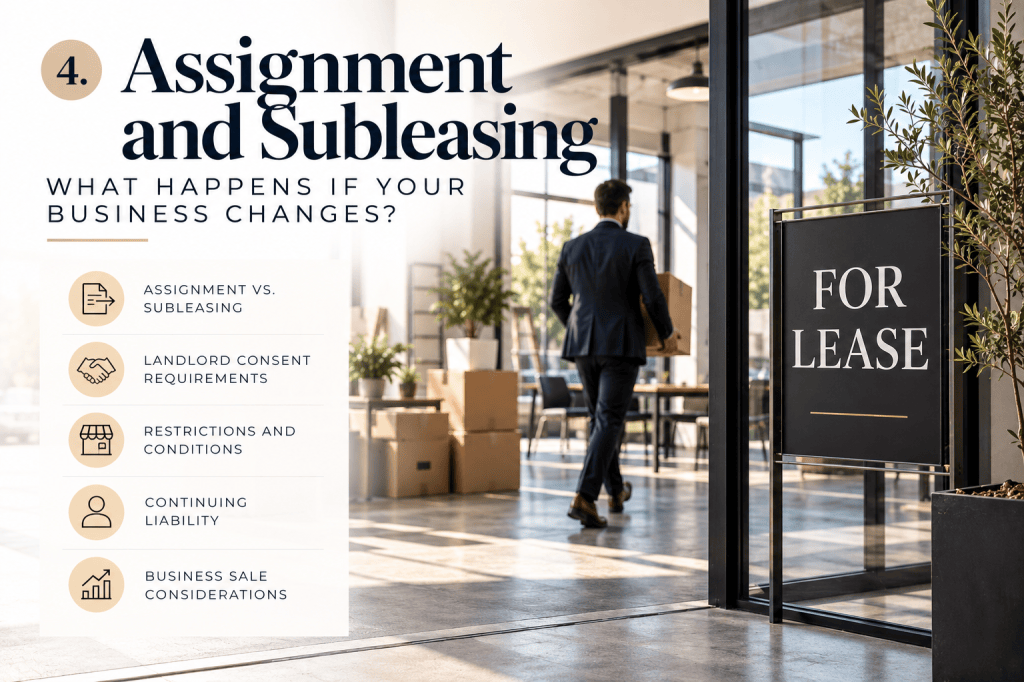
4. Assignment and Subleasing: What Happens If Your Business Changes?
Businesses evolve.
Sometimes they grow.
Sometimes they downsize.
Sometimes they’re sold.
Sometimes the owner retires.
Sometimes a business needs to relocate before the lease expires.
So here’s an important question:
What happens if you need to leave your commercial space before the lease ends?
The answer may depend heavily on the assignment and subleasing provisions.
What’s the Difference?
An assignment generally involves transferring the tenant’s leasehold interest to another party, subject to the terms of the lease and applicable law.
A sublease generally involves the original tenant leasing some or all of the premises to another party while retaining its underlying leasehold interest.
The legal and financial consequences can differ.
Why These Clauses Matter
Imagine your business is growing rapidly.
You need twice as much space.
But you’re only two years into a five-year lease.
You find another business willing to occupy your current location.
Problem solved?
Maybe.
But the lease might require landlord consent before an assignment or sublease.
It may also contain restrictions relating to:
- Permitted uses
- Tenant qualifications
- Financial strength
- Sublease terms
- Assignment fees
- Sharing profits from a transfer
- Continuing liability of the original tenant
Even if a landlord approves an assignment, the original tenant or guarantor may remain liable unless properly released.
Selling Your Business Can Create Another Issue
Suppose you decide to sell your company.
The buyer wants to continue operating from the same location.
Does the lease permit the transfer?
Does the landlord need to approve it?
Could a change in ownership trigger an assignment provision?
Will you remain personally responsible after the sale?
These are questions worth answering before a business sale is underway.
What Should You Look For?
Understand:
Whether assignment or subleasing is permitted.
When landlord consent is required.
Whether consent is subject to a reasonableness standard.
Whether the original tenant remains liable.
How a business sale or ownership change is treated.
What fees or other conditions may apply.
A lease with reasonable flexibility may be valuable to a business whose needs could change during the term.
Don’t assume you can simply find someone else to take over your space.
Read the transfer provisions first.
5. Renewal Options and Rent Increases: What Happens After Year One?
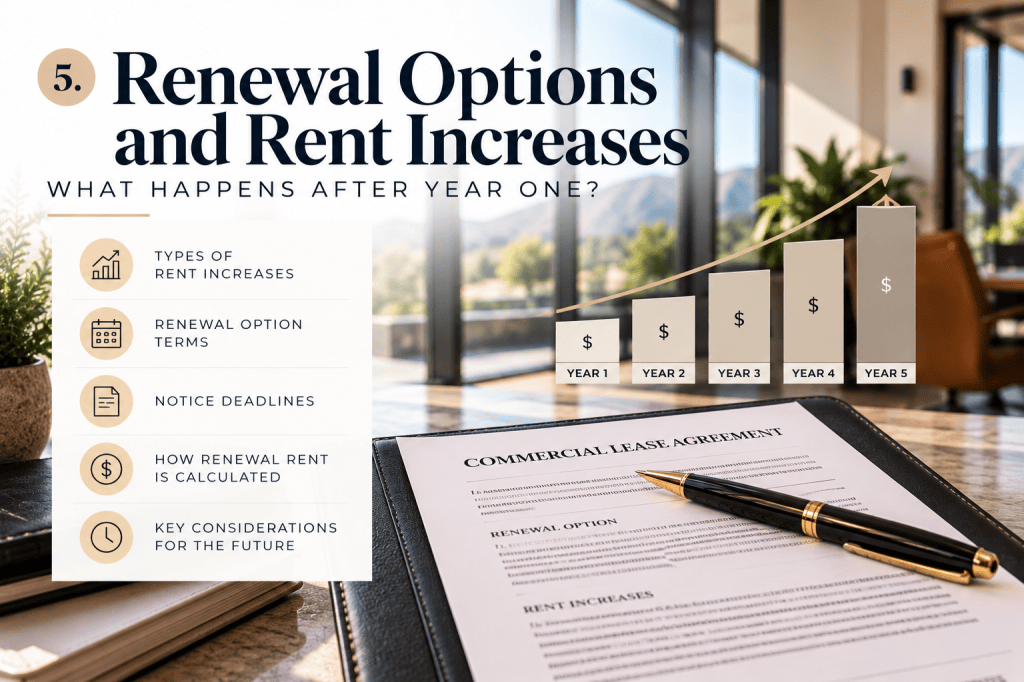
Business owners often focus heavily on the starting rental rate.
But commercial leases are frequently multi-year commitments.
The amount you pay in the first month may be very different from the amount you pay in the final year.
And when the lease expires, your ability to remain in the space may depend on the terms you negotiated years earlier.
Annual Rent Increases
Commercial leases may provide for scheduled increases.
These could include:
- Fixed dollar increases
- Fixed percentage increases
- Periodic adjustments
- Consumer Price Index-based adjustments
- Other negotiated formulas
Let’s look at a hypothetical example.
Your initial monthly base rent is:
$5,000
Your lease includes a 3% annual increase.
| Lease Year | Monthly Base Rent |
|---|---|
| Year 1 | $5,000.00 |
| Year 2 | $5,150.00 |
| Year 3 | $5,304.50 |
| Year 4 | $5,463.64 |
| Year 5 | $5,627.54 |
By Year 5, your monthly base rent is approximately $628 higher than when you started.
That’s before considering any additional operating expenses.
The increases may be reasonable for the transaction.
But they should be understood and budgeted for.
Renewal Options
Now imagine your business has spent five years building a customer base at the location.
You’ve invested in improvements.
Customers know where to find you.
Your employees are comfortable.
Business is strong.
You want to stay.
But what happens if the lease doesn’t provide a renewal option?
You may have to negotiate a new agreement with the landlord, and there’s no guarantee the parties will reach acceptable terms.
A properly negotiated renewal option can provide a contractual opportunity to extend the lease, subject to its specific conditions.
Pay Attention to the Details
Renewal options may specify:
- The length of the extension
- How rent will be determined
- The deadline for giving notice
- The required form of notice
- Whether the tenant must be free of default
- Whether the option is personal to the original tenant
- Other conditions
Missing a notice deadline could mean losing the option.
And if the renewal rent is based on fair market value, the lease should be reviewed for how that value will be established.
Think Beyond the Initial Lease Term
Before signing, ask:
What will my rent be in three years?
What will it be in five years?
Do I have the right to renew?
How is renewal rent calculated?
When must I provide notice?
Will this location still support my business at the end of the term?
The right lease should make sense for the business you’re operating today and the business you’re planning to operate tomorrow.
Bonus: The Permitted Use Clause

There’s one more provision I don’t want to leave out.
The permitted use clause.
This provision defines how the premises may be used under the lease.
Imagine leasing a space for a retail business.
Two years later, you want to add another product line or service.
Maybe you want to expand into food service.
Maybe you want to add a complementary business activity.
But the lease permits only a narrowly defined use.
That could create a problem.
Even if a landlord agrees to broaden the permitted use, the proposed activity may still require zoning approval, permits, building modifications, or other governmental approvals.
Before Signing
Make sure the permitted use language accurately reflects what your business does.
Consider whether reasonable future activities should also be included.
And independently confirm that the intended use is legally permissible at the property.
A landlord’s permission in a lease does not replace required governmental approvals.
Let’s Look at the Bigger Picture
Imagine you’re comparing two commercial properties.
Both have the same:
Square footage.
Location quality.
Starting rent.
Lease term.
On paper, they appear nearly identical.
But Property A has:
A broad personal guarantee.
Significant tenant repair obligations.
Strict assignment restrictions.
No renewal option.
Uncapped operating expense pass-throughs.
Property B has:
More clearly defined repair responsibilities.
A negotiated limitation on the guarantee.
More flexible assignment language.
A renewal option.
Certain negotiated protections relating to operating expenses.
The two leases could create very different financial and operational outcomes.
And yet, the asking rent is identical.
That’s why commercial lease negotiations shouldn’t stop when the parties agree on the monthly rent.
A Practical Lease Review Checklist
Before signing a commercial lease, make sure you understand the answers to these questions.
Financial Obligations
- What is the starting base rent?
- How and when does rent increase?
- What operating expenses are passed through?
- How are those expenses calculated?
- Are there additional fees or charges?
- What security deposit is required?
Maintenance and Repairs
- Who maintains the HVAC?
- Who pays for major equipment replacement?
- Who maintains the roof and structure?
- Who handles common areas?
- What condition must the premises be returned in?
Personal Liability
- Is a personal guarantee required?
- What obligations does it cover?
- Are there negotiated limitations?
- When, if ever, does the guarantee end?
Flexibility
- Can the lease be assigned?
- Can the space be subleased?
- What happens if the business is sold?
- Can the business expand or downsize?
- Are there early termination provisions?
Long-Term Planning
- Are renewal options included?
- What are the notice deadlines?
- How will renewal rent be calculated?
- Does the permitted use allow the intended business operations?
- What happens if the business needs change?
Not every question will apply equally to every transaction.
But understanding the answers can help business owners avoid expensive surprises.
Don’t Wait Until There’s a Problem to Read the Lease
It’s easy to focus on the exciting part of leasing commercial real estate.
Finding the space.
Designing the interior.
Planning the grand opening.
Moving equipment.
Putting up the sign.
But the lease governs important aspects of the relationship between the landlord and tenant long after opening day.
And many of the provisions that seem unimportant at signing become extremely important when something changes.
The air conditioning fails.
Operating expenses increase.
The business grows.
The owner wants to retire.
A buyer wants to purchase the company.
The lease is approaching expiration.
Those are the moments when the details matter.
Final Thoughts
A commercial lease is more than an agreement about rent.
It’s a contract that can affect how your business operates, what expenses you’re responsible for, how much flexibility you have, and what happens when circumstances change.
Before signing, understand these five areas:
1. Operating expenses
2. Maintenance and repairs
3. Personal guarantees
4. Assignment and subleasing
5. Renewal options and rent increases
And don’t overlook the permitted use clause.
Not every lease provision is negotiable in every transaction, and the appropriate terms depend on the property, business, market, and parties involved.
But understanding what you’re agreeing to puts you in a much better position to evaluate the opportunity.
Because the most important number in a commercial lease isn’t always the monthly rent.
Sometimes it’s the financial obligation you didn’t realize you were accepting.
Looking for Commercial Space in San Luis Obispo County?

Whether you’re leasing your first commercial property, expanding your business, relocating, or approaching a lease renewal, understanding the terms of your lease is an important part of making an informed decision.
At Trujillo Commercial Real Estate Group, we work with commercial property owners and businesses throughout San Luis Obispo County.
Our goal is to help clients evaluate commercial real estate opportunities with a clear understanding of the property, market, and business considerations involved.
Contact Rod Trujillo to discuss your commercial real estate needs.
Rod Trujillo | Commercial Real Estate Broker

Trujillo Commercial Real Estate Group
Phone: 805-439-4733
Email: rod@trujillo-group.com
Website: www.trujillo-group.com
This article provides general commercial real estate information and is not legal or tax advice. Commercial lease rights and obligations depend on the specific agreement and applicable law. Have a qualified California commercial real estate attorney review lease documents before signing.
Continue Exploring the Resource Center
Should You Renew Your Commercial Lease or Move? A Business Owner’s Guide
How Much Commercial Space Does Your Business Actually Need?
Before You Tour a Commercial Space, Look at These 7 Things Outside
The Cheapest Commercial Space Could Cost Your Business the Most
Understanding Triple Net (NNN) Leases: What Every Business Owner Should Know