By Rod Trujillo, Commercial Real Estate Broker
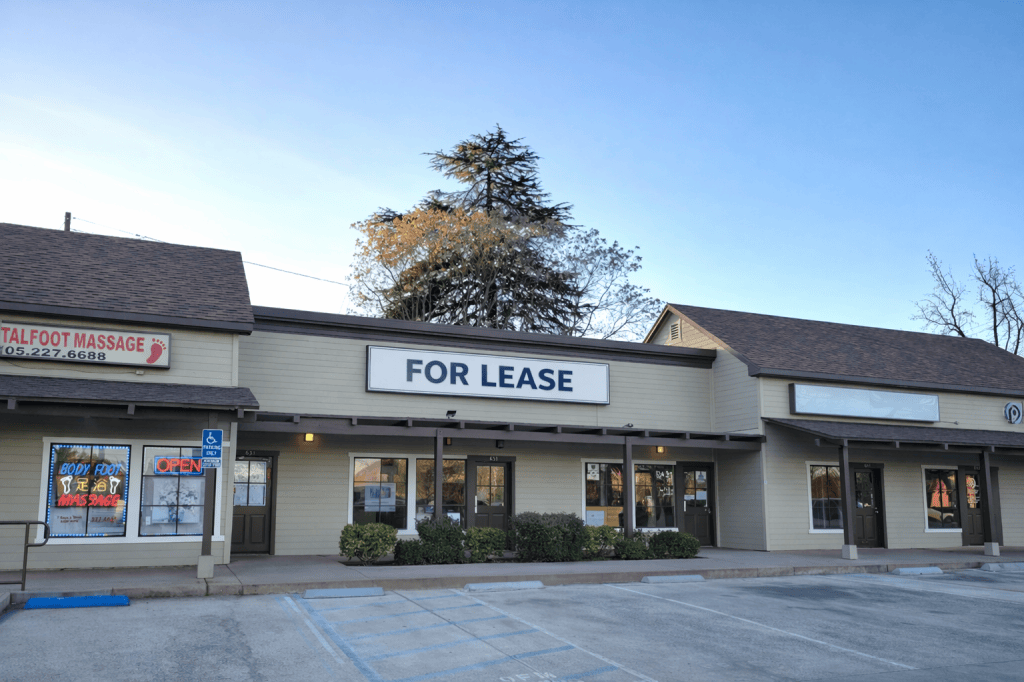
If you’re looking for commercial space, you may come across a listing that looks something like this:
$2.00/SF/MO NNN
At first glance, it might seem straightforward. Take the square footage, multiply it by the rental rate, and you know what the space will cost.
Not quite.
The three letters at the end — NNN — can make a meaningful difference in what you actually pay to occupy the property.
A Triple Net lease is one of the most common lease structures in commercial real estate, particularly for retail and industrial properties. Yet it is also one of the areas where I see business owners become confused.
The advertised base rent is only part of the picture.
Before comparing commercial spaces or signing a lease, you need to understand what expenses are being passed through to you, how those expenses are calculated, and what your total occupancy cost may actually be.
This guide explains Triple Net leases in practical terms and highlights the questions every commercial tenant should be asking.
In This Guide
- In This Guide
- 1. Property Taxes
- 2. Property Insurance
- 3. Common Area Maintenance (CAM)
- Triple Net (NNN)
- Full-Service Lease
- Modified Gross Lease
- Mistake #1: Looking Only at Base Rent
- Mistake #2: Treating the NNN Estimate as Fixed
- Mistake #3: Not Asking What CAM Includes
- Mistake #4: Ignoring Repair Responsibilities
- Mistake #5: Comparing Properties Using Different Lease Structures
- Mistake #6: Focusing on Rent and Ignoring the Business
- What does NNN stand for?
- Is NNN included in the advertised rent?
- Are utilities included in NNN?
- Are NNN charges fixed?
- What is CAM?
- Who pays for HVAC in an NNN lease?
- Can I negotiate an NNN lease?
- Should I have an attorney review a commercial lease?
What Is a Triple Net (NNN) Lease?
A Triple Net lease, commonly written as NNN, is a commercial lease structure in which the tenant generally pays a base rental rate plus a share of certain operating expenses associated with the property.
The three traditional expense categories are:
Property Taxes
Property Insurance
Common Area Maintenance
Those are the three “nets.”
The important thing to understand is that the exact responsibilities vary from lease to lease.
Two properties can both advertise themselves as NNN and still allocate expenses differently.
That is why I tell tenants:
Don’t stop at asking, “What’s the rent?” Ask, “What’s my total occupancy cost?”
The Three Nets Explained
1. Property Taxes
In a Triple Net lease, tenants commonly reimburse the landlord for their proportionate share of the real estate taxes associated with the property.
If a tenant occupies only part of a multi-tenant building or shopping center, the tenant may pay a percentage based on its share of the property’s leasable area, subject to the terms of the lease.
Property taxes can change over time, so this portion of the tenant’s expenses may change as well.
2. Property Insurance
Tenants may also reimburse the landlord for a portion of the insurance maintained on the property.
This is generally separate from the tenant’s own business insurance.
A commercial tenant may therefore have both:
Its own insurance obligations under the lease, and
A proportionate share of certain property insurance expenses passed through by the landlord.
Understanding the distinction is important when estimating the true cost of occupancy.
3. Common Area Maintenance (CAM)
The third component is commonly referred to as CAM, or Common Area Maintenance.
CAM generally covers expenses associated with maintaining and operating portions of a commercial property that benefit multiple tenants.
Depending on the property and lease, these expenses may include items such as:
- Parking lot maintenance
- Landscaping
- Exterior lighting
- Common-area utilities
- Trash service
- Property management
- Common-area cleaning
- Security
- Repairs and maintenance
- Other expenses permitted by the lease
CAM can be one of the most important sections of a commercial lease to understand because the definition of recoverable expenses can vary considerably.
How Is NNN Rent Calculated?
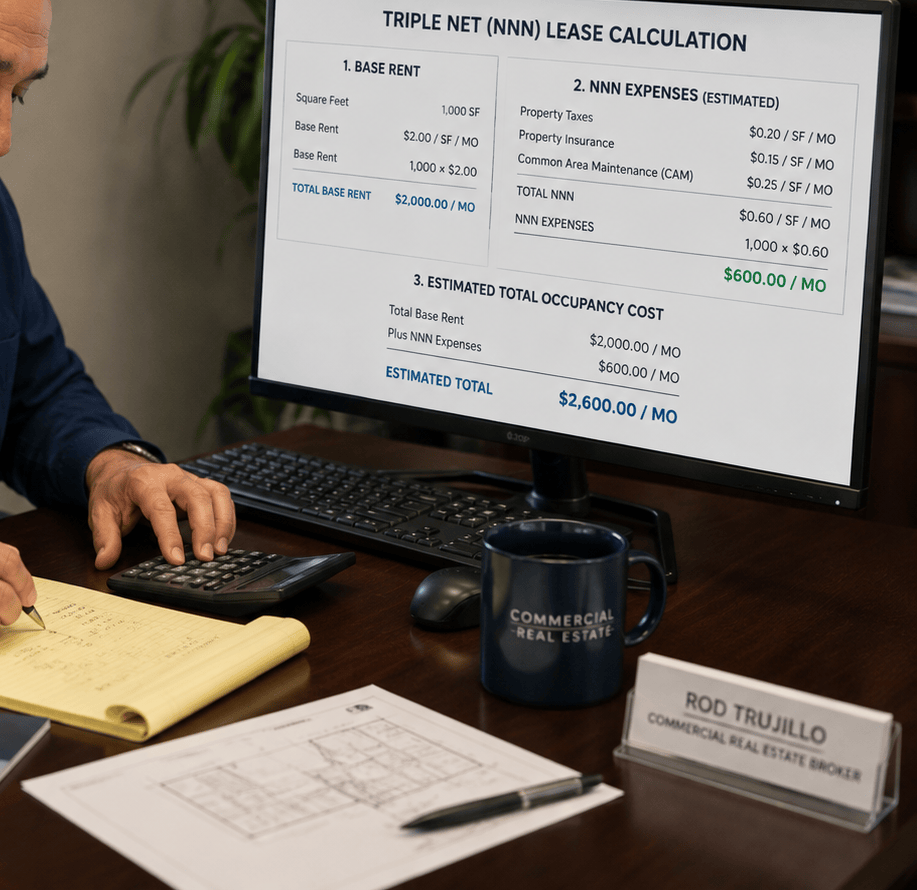
Let’s use a simplified example.
Suppose you’re considering a 1,000-square-foot commercial space.
The advertised base rent is:
$2.00 per square foot per month
The estimated NNN expenses are:
$0.60 per square foot per month
Your estimated monthly calculation would look like this:
Base Rent
1,000 SF × $2.00 = $2,000 per month
Estimated NNN Expenses
1,000 SF × $0.60 = $600 per month
Estimated Total
$2,000 + $600 = $2,600 per month
And that still may not represent every cost of occupying the space.
Depending on the lease, you could also be responsible for expenses such as utilities, internet, janitorial service, business insurance, repairs, maintenance, or other operating costs.
This is why comparing commercial properties based solely on the advertised base rent can be misleading.
Base Rent vs. Total Occupancy Cost
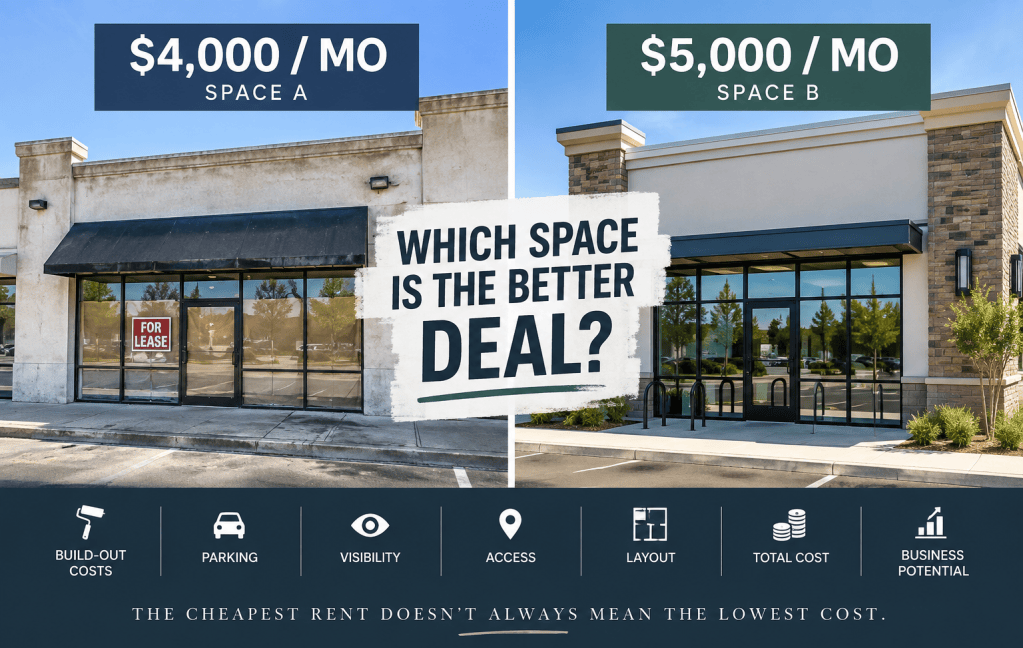
Imagine you’re comparing two spaces.
Property A
Base rent: $1.90/SF
NNN: $0.75/SF
Estimated combined amount:
$2.65/SF
Property B
Base rent: $2.10/SF
NNN: $0.40/SF
Estimated combined amount:
$2.50/SF
Property A initially appears less expensive because it has the lower base rental rate.
Once the estimated NNN expenses are included, Property B actually has the lower combined figure in this simplified example.
Neither property is automatically the better choice. Location, condition, parking, layout, tenant improvements, lease terms, and many other factors still matter.
But this illustrates why tenants should compare total costs rather than headline rents.
What Are CAM Charges?
CAM stands for Common Area Maintenance.
Think about a shopping center.
You may lease the four walls of your individual storefront, but your customers also use:
- The parking lot
- Sidewalks
- Exterior lighting
- Landscaping
- Common signage
- Shared access areas
Those areas need to be maintained.
Under many commercial leases, some or all of those expenses are allocated among the tenants according to the terms of their leases.
CAM expenses may also include administrative or management-related costs if permitted by the lease.
The important question isn’t simply:
“Do I pay CAM?”
It’s:
“What exactly is included in CAM under this lease?”
Ask for the NNN Estimate
Before signing a lease, ask the landlord or broker for the current estimated NNN charges.
But don’t stop there.
If available and appropriate for the transaction, you may also want to understand:
- What the NNN expenses were in prior periods
- What is included in the estimate
- How your proportionate share is calculated
- How often expenses are reconciled
- Whether there are exclusions or limitations
- Whether certain expenses can increase without a cap
- How capital expenditures are treated under the lease
Historical information does not guarantee future expenses, but it may help you better understand how the property has operated.
Why Can NNN Expenses Change?
NNN expenses generally are not fixed in the same way base rent may be fixed for a particular period.
Property taxes can change.
Insurance premiums can change.
Landscaping costs can change.
Utilities can change.
Maintenance costs can change.
Unexpected repairs can occur.
That means a tenant’s NNN charges may increase or decrease depending on actual property expenses and the lease terms.
This is an important budgeting consideration.
If your business can only afford the space when every operating expense remains exactly where it is today, you may not have enough room in your budget for future fluctuations.
Estimated Charges and Reconciliation
Many landlords collect estimated NNN expenses from tenants throughout the year.
At some point, the landlord may compare those estimated collections with the property’s actual recoverable expenses.
This is often called a reconciliation.
If the tenant’s estimated payments were lower than its allocated share of actual recoverable expenses, the tenant may owe additional money.
If the tenant paid more than required, the lease may provide for a credit or other adjustment.
The exact process depends on the lease.
This is another reason tenants should understand that the NNN estimate quoted when touring a property may not necessarily be the final amount paid for that period.
NNN vs. Full-Service vs. Modified Gross
Triple Net isn’t the only commercial lease structure.
Triple Net (NNN)
The tenant generally pays:
Base rent + certain property operating expenses
This structure is common in retail and industrial properties, although it can be used elsewhere.
Full-Service Lease
The landlord generally pays many of the building’s operating expenses and incorporates those costs into the rental structure.
Full-service leases are often associated with office properties, although terminology and expense treatment vary.
Modified Gross Lease
A modified gross lease falls somewhere between the two.
The landlord and tenant divide operating expenses according to the specific lease.
There is no universal modified gross structure.
The lesson is simple:
The name of the lease matters less than what the lease actually says.
Is a Triple Net Lease Bad for the Tenant?
No.
A Triple Net lease isn’t inherently good or bad.
It’s simply a way of allocating property expenses.
NNN leases can provide tenants with greater transparency into certain operating costs because base rent and expense reimbursements are identified separately.
For landlords, the structure can help allocate changes in property operating expenses among tenants.
What matters is whether the total economics and responsibilities of the lease make sense for your business.
A well-located property with a reasonable NNN structure may be a much better business decision than a cheaper gross lease in a location that doesn’t work.
Don’t evaluate the lease structure in isolation.
What Should You Ask Before Signing an NNN Lease?
Before committing to a Triple Net lease, I would want answers to questions such as:
What is the current estimated NNN charge?
Know the estimate in addition to the base rent.
What expenses are included?
Ask for a clear explanation of the categories being passed through.
How is my share calculated?
Understand the method used to determine your proportionate share.
How have expenses changed?
Historical expenses may provide useful context when available.
How often are expenses reconciled?
Understand when estimates are compared with actual expenses.
Are there caps on certain increases?
Some leases may limit increases in particular controllable operating expenses. Others may not.
How are major repairs handled?
Understand who is responsible for items such as the roof, structure, HVAC, plumbing, parking lot, and other major building systems.
How are capital expenditures treated?
The lease should explain whether and under what circumstances capital costs may be passed through to tenants.
What happens if the property is reassessed or insurance costs increase significantly?
Understand how those changes could affect your obligations.
The HVAC Question
Here’s an expense business owners sometimes overlook:
Who is responsible for the HVAC system?
Depending on the lease, a tenant may have responsibility for maintaining, repairing, or potentially replacing HVAC equipment serving the premises.
That can be very different from leasing an apartment or residential property, where tenants may be accustomed to the owner handling major building systems.
Before signing, understand:
- Who maintains the HVAC?
- Is a service contract required?
- Who pays for repairs?
- Who pays if the unit needs replacement?
- How old is the equipment?
- Is there any warranty?
A lease that appears inexpensive can become much more expensive if the tenant unexpectedly assumes significant repair obligations.
Common NNN Lease Mistakes
Mistake #1: Looking Only at Base Rent
This is the most common problem.
A space advertised at $2.00/SF NNN does not necessarily cost only $2.00/SF to occupy.
Ask about the additional expenses.
Mistake #2: Treating the NNN Estimate as Fixed
An estimate is exactly that — an estimate.
Understand how actual expenses are reconciled.
Mistake #3: Not Asking What CAM Includes
Don’t assume every landlord defines CAM the same way.
Read the lease.
Mistake #4: Ignoring Repair Responsibilities
HVAC, plumbing, glass, doors, electrical systems, and other repairs can become significant expenses.
Know who is responsible.
Mistake #5: Comparing Properties Using Different Lease Structures
A $2.50/SF full-service lease and a $2.00/SF NNN lease cannot necessarily be compared based on those two numbers alone.
Put the costs on as close to an apples-to-apples basis as possible.
Mistake #6: Focusing on Rent and Ignoring the Business
The lowest occupancy cost doesn’t automatically make a property the best location.
If your customers can’t find you, your employees can’t park, or your operation doesn’t fit the building, saving a few cents per square foot may not matter much.
Can NNN Expenses Be Negotiated?
Sometimes certain lease provisions relating to operating expenses can be negotiated.
Depending on the property, landlord, market, and transaction, discussions might address matters such as:
- Caps on increases in certain controllable expenses
- Audit or review rights
- Exclusions from operating expenses
- Administrative or management fees
- Treatment of capital expenditures
- Repair responsibilities
- Base-year or expense-stop structures in other lease types
Not every landlord will agree to every request, and not every provision is appropriate for every transaction.
But tenants should understand the expense provisions before agreeing to them.
A Better Way to Compare Commercial Spaces
When comparing properties, create a simple occupancy worksheet for each option.
Include:
Base rent
Estimated NNN/CAM
Utilities
Insurance
Maintenance obligations
Tenant improvements
Parking costs, if applicable
Signage
Other recurring expenses
Then look beyond the spreadsheet.
Consider:
Location
Visibility
Access
Parking
Layout
Zoning
Customer convenience
Employee convenience
Room for growth
The goal isn’t to find the cheapest commercial space.
It’s to find the space that creates the best overall fit for your business.
Frequently Asked Questions
What does NNN stand for?
NNN stands for Triple Net. The three traditional “nets” are property taxes, property insurance, and common area maintenance.
Is NNN included in the advertised rent?
Usually, a listing advertised as a base rental rate “NNN” indicates that estimated NNN expenses are additional to the stated base rent. Always confirm the exact pricing structure for the property.
Are utilities included in NNN?
Not necessarily. Utilities may be separately metered, allocated, included in certain common-area expenses, or handled another way depending on the property and lease.
Are NNN charges fixed?
Generally, NNN charges can change because they are tied to property operating expenses. The lease determines how estimates, increases, and reconciliations are handled.
What is CAM?
CAM means Common Area Maintenance. It generally refers to certain expenses associated with operating and maintaining shared portions of a commercial property.
Who pays for HVAC in an NNN lease?
It depends on the lease. Tenants may have maintenance or repair responsibilities for HVAC equipment serving their premises, while other leases allocate those responsibilities differently.
Can I negotiate an NNN lease?
Commercial lease provisions are often negotiable, but the amount of negotiating leverage depends on the property, market, landlord, tenant, lease term, and other transaction factors.
Should I have an attorney review a commercial lease?
Commercial leases create significant legal and financial obligations. Tenants should consider having qualified legal, financial, tax, and other appropriate professionals review matters within their areas of expertise before signing.
Final Thoughts
The three letters NNN should never be treated as fine print.
They are an important part of understanding what a commercial property may actually cost your business.
When evaluating a Triple Net lease, don’t simply ask:
“What’s the rent?”
Ask:
“What will it cost me to occupy and operate from this property — and what responsibilities am I taking on?”
That question leads to a much better conversation.
After more than 25 years in commercial real estate, I’ve found that the strongest transactions usually happen when business owners understand the economics of a property before they commit to it.
The goal isn’t simply to sign a lease.
It’s to put your business in a position to succeed.
Looking for Commercial Space in San Luis Obispo County?
If you’re evaluating retail, office, industrial, or other commercial space in San Luis Obispo County, I can help you compare locations, understand lease structures, evaluate occupancy costs, and navigate the commercial leasing process.
Contact Rod Trujillo to discuss your commercial real estate goals.
Continue Exploring the Resource Center
How to Lease Commercial Space in San Luis Obispo County: A Step-by-Step Guide
The Complete Guide to Commercial Real Estate in San Luis Obispo County
San Luis Obispo County Commercial Real Estate Market Update
Coming soon:
Should You Lease or Buy Commercial Property?
Tenant Representation vs. Landlord Representation
How to Choose the Right Location for Your Business