A Business Owner’s Guide
By Rod Trujillo, Commercial Real Estate Broker
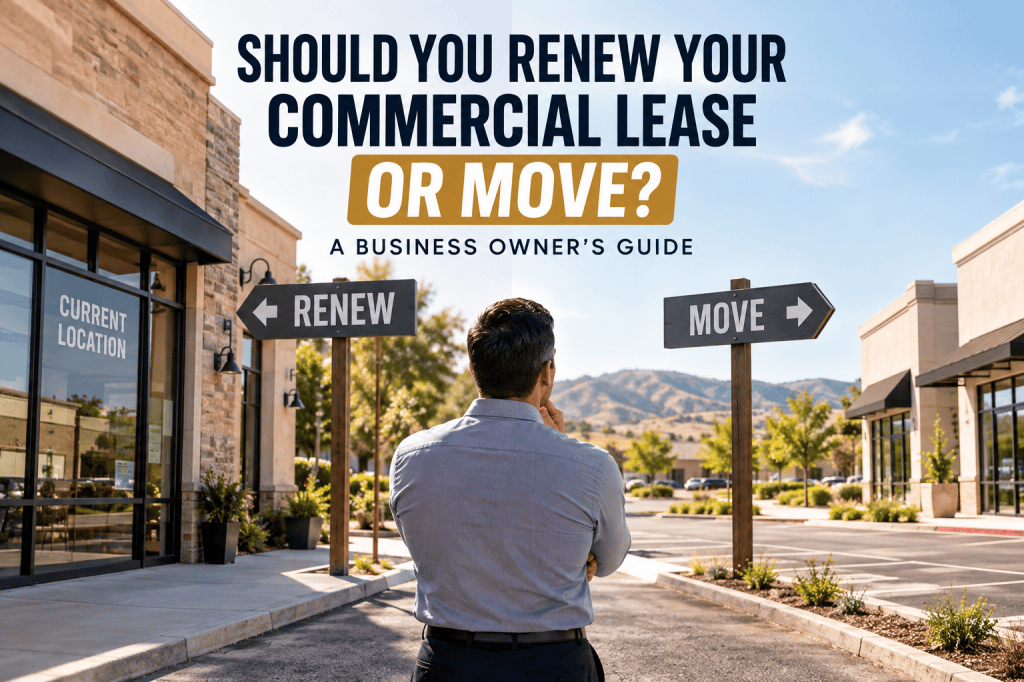
Your commercial lease is coming up for renewal.
The landlord sends over a proposal.
Maybe the rent is increasing.
Maybe the terms look reasonable.
Maybe you’ve been in the same location for years and moving sounds like a headache.
So you sign the renewal.
Easy.
But before you do, there’s a question worth asking:
If I were choosing a location for my business today, would I still choose this one?
That’s a very different question from:
“Do I want to move?”
Businesses change.
Employees change.
Customers change.
Neighborhoods change.
Commercial rents change.
And the space that was perfect five years ago may not be the best fit for the business you’re running today.
On the other hand, moving simply because another property looks newer or cheaper can create unnecessary expense and disruption.
So when your commercial lease is approaching expiration, don’t automatically stay.
And don’t automatically move.
Use the renewal as an opportunity to reevaluate the real estate.
In This Guide
Start Earlier Than You Think
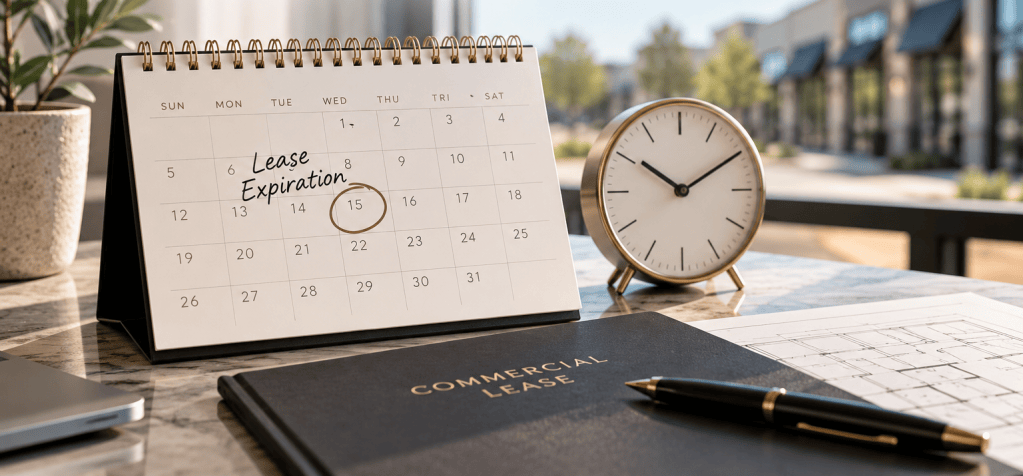
One of the biggest mistakes I see businesses make is waiting until their lease is almost over to think about what comes next.
If your lease expires in 60 days and you haven’t looked at alternatives, how much leverage do you really have?
Moving a business can require time for:
Finding a property
Negotiating a lease
Designing improvements
Permitting
Construction
Installing equipment
Moving
Signage
Utilities
Internet and technology
Licensing or approvals
Depending on the business and property, that process can take months.
That’s why I generally prefer businesses to begin thinking about their real estate well before the expiration date.
For many businesses, starting the conversation 6–12 months before expiration can be reasonable.
For larger, specialized, highly improved, or difficult-to-relocate operations, even more time may be appropriate.
The exact timeline depends on the business and market.
The point is simple:
Don’t let the calendar make the decision for you.
The Most Important Question

Before looking at rent, ask:
Does this space still work for the business?
Think about when you originally leased it.
Maybe you had:
Five employees.
Now you have fifteen.
Maybe customers rarely visited.
Now you’re appointment-heavy.
Maybe inventory was minimal.
Now every spare room is storage.
Maybe the location had excellent visibility.
Then trees grew, signage changed, or traffic patterns shifted.
Maybe the neighborhood around you improved dramatically.
Or perhaps it moved in the opposite direction.
A lease renewal should trigger an operational review.
Ask:
Do we have enough space?
Do we have too much space?
Does the layout still work?
Is parking still adequate?
Can customers find us easily?
Does the location still serve our customer base?
Does it work for employees?
Are we using the space efficiently?
Do we expect the business to change significantly during another lease term?
If the space still works extremely well, that’s valuable.
Don’t underestimate it.
Familiarity Has Value
There are real benefits to staying in an existing location.
Your customers know where you are.
Employees know the commute.
Your signage is installed.
The space is already built around the business.
Your equipment is there.
Utilities and technology are functioning.
Your address is established online.
Your operations don’t need to stop for a move.
You may have invested substantial money into the property already.
There is value in all of that.
Sometimes business owners become so focused on finding a “better deal” that they underestimate the cost of disrupting a location that already works.
Moving has a cost even when the new rent is lower.
But Familiarity Can Also Hide Problems
The opposite is true too.
You can get used to things that aren’t working.
Customers struggle to park?
“It’s always been like that.”
Employees are crammed together?
“We make it work.”
Storage is overflowing?
“We’ll reorganize.”
Rent has climbed significantly?
“Moving is too much trouble.”
At some point, inconvenience becomes normal.
That’s why I like the question:
If you weren’t already here, would you lease this space today?
If the answer is an immediate yes, that’s useful information.
If you hesitate, figure out why.
Compare the Renewal to the Market
Suppose your landlord offers a renewal at:
$3.00/SF/month
Is that good?
We don’t know.
Not until we understand what comparable alternatives look like.
Maybe similar spaces are asking:
$3.50/SF
In that case, $3.00 could be attractive.
Or maybe comparable options are available around:
$2.50/SF
Now we have a different conversation.
But asking rent alone still isn’t enough.
As we discussed in a previous article, the cheapest commercial space can sometimes cost your business the most.
You need to compare the total package.
That includes:
Base rent
NNN or operating expenses
Annual increases
Tenant improvements
Parking
Visibility
Access
Layout
Signage
Condition
Location
Lease term
And the cost of actually moving.
Let’s Run a Simple Example
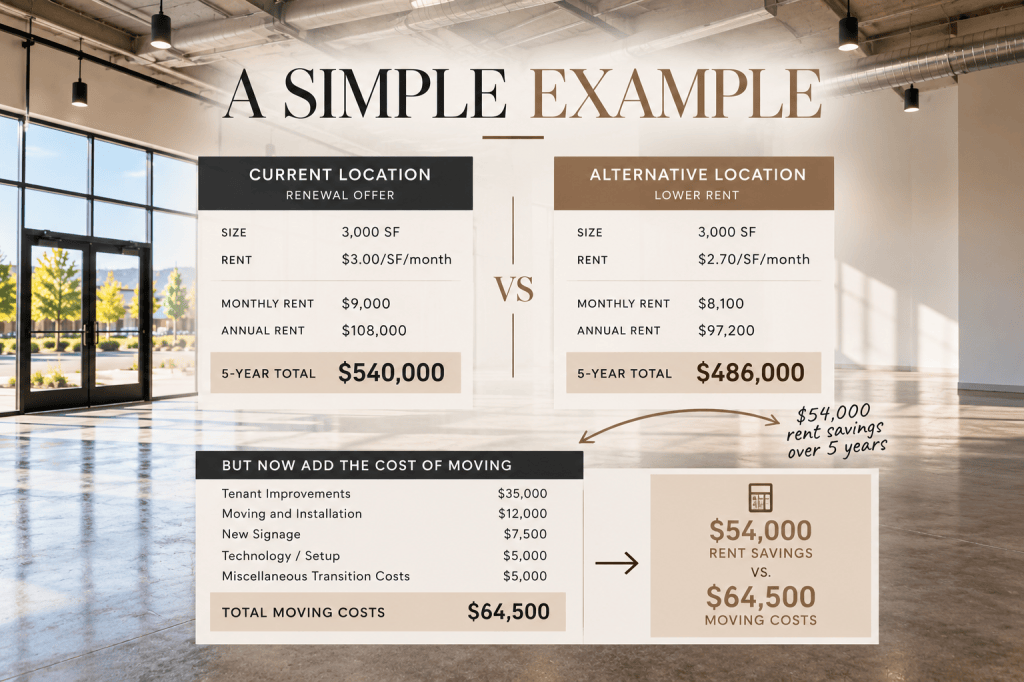
Imagine your business occupies 3,000 square feet.
Your landlord offers a five-year renewal at:
$3.00/SF/month
For simplicity, we’ll ignore annual increases and additional expenses.
Your base rent would be:
3,000 × $3.00 = $9,000/month
or:
$108,000/year
Over five years:
$540,000
Now you find another property at:
$2.70/SF/month
That’s:
$8,100/month
or:
$97,200/year
Over five years:
$486,000
At first glance, moving saves:
$54,000
Sounds pretty good.
But we’re not finished.
Now Add the Cost of Moving
Suppose the new location requires:
Tenant improvements: $35,000
Moving and installation: $12,000
New signage: $7,500
Technology / setup: $5,000
Miscellaneous transition costs: $5,000
Total:
$64,500
Your apparent $54,000 rent savings has now disappeared.
And we still haven’t considered:
Lost productivity
Potential downtime
Address changes
Customer confusion
Employee impact
Overlap between leases
Professional fees
Permitting
Or the risk that construction takes longer than expected.
This doesn’t mean you should stay.
It means:
A lower rent doesn’t automatically make moving cheaper.
Now Change the Scenario
What if the new location costs the same to move into, but it also provides:
Better parking
Better visibility
A more efficient layout
Room for growth
Better access
A stronger customer location
And the ability to operate in 2,600 square feet instead of 3,000?
Now the analysis changes again.
Commercial real estate decisions aren’t made by looking at one number.
They’re made by understanding how the property affects the business.
When Staying May Make Sense
Renewing may be attractive when:
Your current location works well operationally.
The proposed rent is competitive.
Parking and access work.
Customers know the location.
The layout fits the business.
You’ve invested heavily in improvements.
Relocating would be expensive.
The business doesn’t need significantly more or less space.
The surrounding area remains strong.
The landlord relationship works.
And the renewal terms support the business’s plans.
If those things are true, staying can be an excellent decision.
There is no prize for moving unnecessarily.
When Moving May Make Sense
Relocation deserves serious consideration when:
You’ve outgrown the space.
You’re paying for space you no longer need.
Parking is hurting the business.
Visibility is poor.
Access is difficult.
The location no longer matches your customers.
The building no longer supports the operation.
Your rent is materially above market.
The property requires improvements that don’t make financial sense.
Your workforce has shifted geographically.
You need different loading, power, ceiling height, storage, or other physical characteristics.
Or another location offers a meaningful strategic advantage.
The key word is meaningful.
Moving is disruptive.
The benefit should justify the disruption.
Growth Can Change the Answer
Maybe your current location is 2,500 square feet.
Today, it’s perfect.
But you’re adding employees quickly.
Your five-year renewal would lock you into a space you’re likely to outgrow in two years.
That matters.
You may want to investigate:
Expansion into an adjacent suite
Expansion rights
A larger property
A shorter renewal
Other negotiated flexibility
The right solution isn’t always “move.”
Sometimes it’s restructuring the current situation so the real estate can grow with the business.
Downsizing Can Be Just as Important
Businesses don’t only grow.
Operations change.
Remote work may reduce office needs.
Inventory systems may become more efficient.
A company may eliminate a department.
A service business may need fewer private offices.
If you’re using only 60% of your current space, renewing the entire premises for another five years deserves careful analysis.
Unused square footage still costs money.
Remember our previous example:
At an all-in occupancy cost of $3.00/SF/month, just 750 unnecessary square feet represents:
$2,250/month
$27,000/year
$135,000 over five years
Before committing to another term, understand how much of the property the business actually uses.
Don’t Negotiate Only the Rent
Commercial lease negotiations involve much more than the starting rental rate.
Depending on the transaction, other important terms may include:
Lease term
Annual increases
Renewal options
Tenant improvement contributions
Repair responsibilities
Operating expenses
Assignment and subletting
Expansion rights
Signage
Parking
Use provisions
Personal guarantees
Security deposits
Exclusivity provisions
Termination rights where applicable
Delivery condition
The relative importance of each provision depends on the business and property.
A slightly higher rent with better overall terms may be more attractive than the lowest rental rate.
The Landlord Is Evaluating the Decision Too
Remember that a renewal is a negotiation between two parties.
From the landlord’s perspective, a good existing tenant may offer significant value.
If you leave, the landlord may face:
Vacancy
Brokerage costs
Tenant improvement costs
Free rent
Marketing time
Construction
Uncertainty about the next tenant
That doesn’t mean every tenant automatically has negotiating leverage.
But it does mean a renewal isn’t simply:
“Here’s the new rent. Take it or leave it.”
Understanding the landlord’s alternatives—as well as your own—can help frame a more informed negotiation.
Know Your Alternatives Before You Negotiate
This is one of the biggest reasons to start early.
If you’ve toured several realistic alternatives, you know:
What rents are being quoted
What sizes are available
What landlords are offering
How much build-out is required
Whether better parking exists
Whether moving would actually improve the business
Now you’re negotiating your renewal with information.
If you haven’t looked at anything else, you’re negotiating based largely on what you hope the market looks like.
Those are very different positions.
Don’t Threaten to Move Unless You Can
Walking into a renewal negotiation and saying:
“Lower the rent or we’re leaving.”
isn’t much of a strategy if you have nowhere to go.
Before using an alternative as leverage, make sure it’s actually an alternative.
Can the business afford it?
Does the property work?
Is the timing realistic?
Can the improvements be completed?
Is the space still available?
Would you genuinely move?
Good negotiations are based on credible options.
Consider the Cost of Doing Nothing
Sometimes the easiest decision is simply signing the renewal.
No tours.
No moving.
No disruption.
But “easy” and “best” aren’t always the same.
Imagine you’re paying $1,000 per month more than necessary for space the business no longer needs.
Over five years:
$60,000
Now add operating expenses associated with that excess square footage.
Doing nothing has a cost too.
A renewal deserves the same level of analysis you would give a new lease.
Build a Stay-vs.-Move Comparison
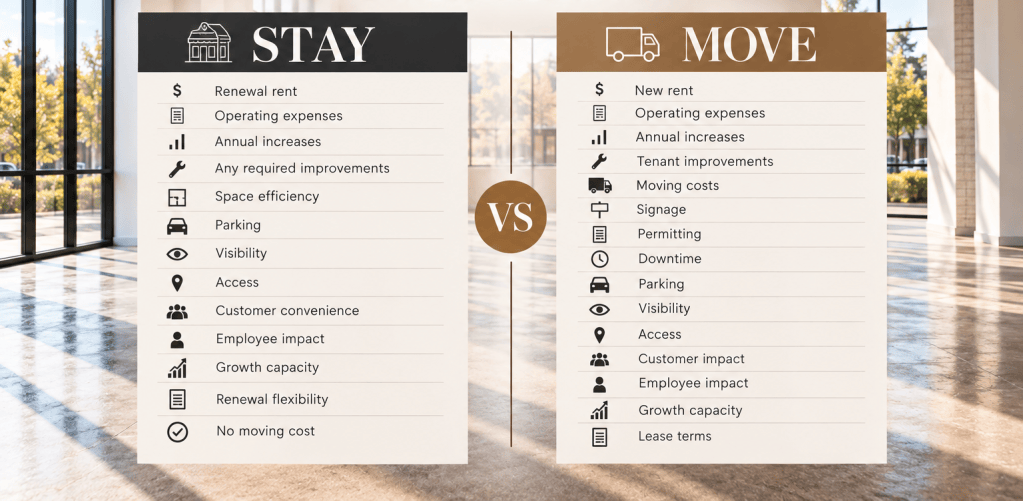
Before deciding, create two columns.
STAY
Renewal rent
Operating expenses
Annual increases
Any required improvements
Space efficiency
Parking
Visibility
Access
Customer convenience
Employee impact
Growth capacity
Renewal flexibility
No moving cost
MOVE
New rent
Operating expenses
Annual increases
Tenant improvements
Moving costs
Signage
Permitting
Downtime
Parking
Visibility
Access
Customer impact
Employee impact
Growth capacity
Lease terms
Then compare them.
Not emotionally.
Operationally and financially.
Sometimes the answer becomes obvious.
Sometimes it doesn’t.
That’s when the details matter.
Give Yourself Three Options
Ideally, when approaching a significant lease expiration, I like having three potential paths:
Option 1: Renew
Understand what staying looks like.
Option 2: Relocate
Identify at least one realistic alternative.
Option 3: Restructure
Could you expand, contract, modify the premises, change the lease term, or negotiate another solution with the existing landlord?
Having multiple options changes the conversation.
You’re no longer asking:
“Should I sign this renewal?”
You’re asking:
“Which real estate strategy makes the most sense for the next stage of the business?”
That’s a much better question.
What If You Love Your Current Location?
Great.
Then the goal isn’t to manufacture a reason to leave.
It’s to make sure the renewal makes sense.
You can love the property and still:
Review market rents
Understand operating expenses
Evaluate lease terms
Plan for growth
Address needed improvements
Discuss signage
Review parking
Negotiate renewal options
A successful renewal isn’t one where somebody “wins.”
It’s one where the real estate continues working for both the tenant and landlord.
What If You Already Know You Want to Leave?
Start early anyway.
Knowing you want to relocate doesn’t mean the right replacement space exists today.
Give yourself enough time to:
Define your requirements
Search the market
Tour properties
Negotiate
Complete due diligence
Plan improvements
Obtain permits where needed
Build out the space
Move
And create contingency time for delays
The more specialized the business, the more important that timeline can become.
A Simple Renewal Timeline
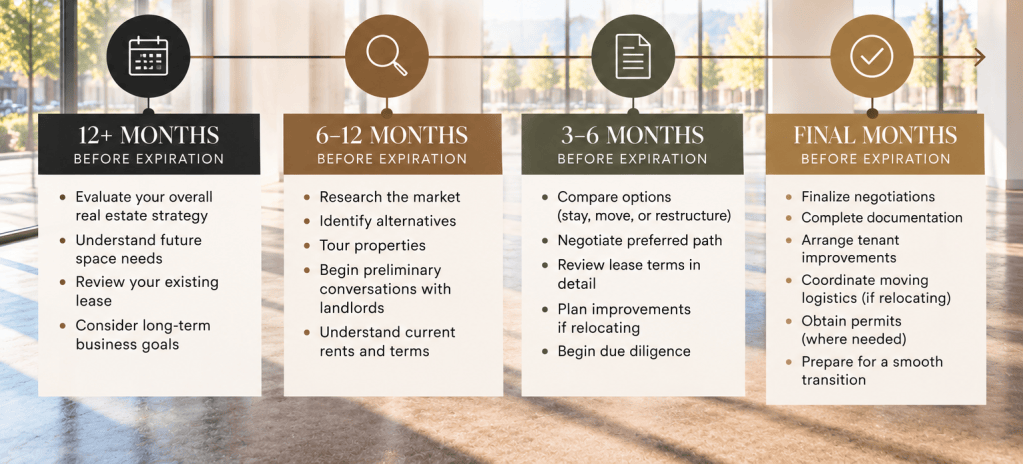
Every situation is different, but conceptually:
12+ Months Before Expiration
For larger or complicated requirements:
Start evaluating strategy.
Understand future space needs.
Review the existing lease.
6–12 Months Before Expiration
Evaluate the market.
Identify alternatives.
Begin preliminary conversations.
3–6 Months Before Expiration
Ideally, you’re actively negotiating the preferred path and have realistic alternatives.
Final Months
Documentation, improvements, moving logistics, and transition planning should be underway if relocating.
This is not a universal timeline.
A small office may require considerably less time.
A large medical, restaurant, industrial, or heavily improved space may require substantially more.
The point is to work backward from the expiration date instead of waiting for it to become urgent.
Seven Questions to Ask Before Renewing
Before signing another commercial lease term, ask:
1. Would I choose this location again today?
If not, why?
2. Is the rent competitive?
Compare the full occupancy cost, not just base rent.
3. Does the space still fit?
Too big and too small can both be expensive.
4. What changes over the next lease term?
Employees, customers, inventory, equipment, or business model?
5. What would moving actually cost?
Include more than rent.
6. What alternatives exist?
Know what’s realistically available.
7. Which option puts the business in the strongest position three to five years from now?
That’s ultimately what matters.
Final Thoughts
A commercial lease expiration isn’t simply an administrative deadline.
It’s a decision point.
You can:
Stay.
Move.
Expand.
Downsize.
Restructure.
Renegotiate.
But before choosing any of them, take a fresh look at the business and the market.
Don’t renew just because moving sounds difficult.
And don’t move just because another property looks exciting.
Ask:
If I were choosing a location for this business today, would I still choose this one?
Then run the numbers.
Look at the alternatives.
Understand the operational impact.
And make the decision based on where the business is going—not simply where it has been.
Is Your Commercial Lease Coming Up for Renewal?
If your business has a commercial lease approaching expiration in San Luis Obispo County, this is the time to start evaluating your options.
I can help you compare your existing location with available alternatives, evaluate commercial lease economics, and understand what the market looks like before you commit to another term.
Contact Rod Trujillo to discuss your commercial real estate needs.
Continue Exploring the Resource Center
How Much Commercial Space Does Your Business Actually Need?
Before You Tour a Commercial Space, Look at These 7 Things Outside
The Cheapest Commercial Space Could Cost Your Business the Most
Tenant Representation in Commercial Real Estate: Who Is Really Representing You?
Understanding Triple Net (NNN) Leases: What Every Business Owner Should Know