By Rod Trujillo, Commercial Real Estate Broker
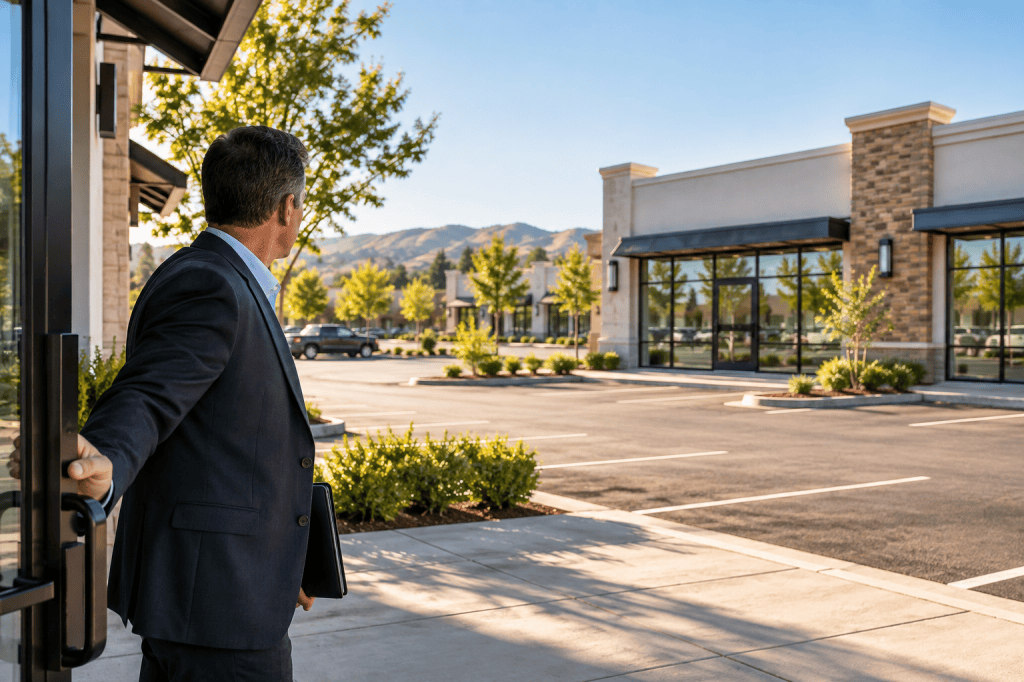
You pull into the parking lot.
The commercial space you’re about to tour looks great online.
The photos are clean. The square footage works. The rent is within budget.
So naturally, you want to get inside and see the space.
But before I open the front door, I’m already evaluating the property.
I’m looking at the parking lot.
The street.
The neighboring businesses.
The signage.
The entrances and exits.
The visibility.
And how the property actually feels when you arrive.
Because here’s something business owners sometimes learn too late:
You can remodel the inside of a commercial space. You can’t move the parking lot.
A beautiful interior can be changed.
Many of the things surrounding it cannot.
Before you fall in love with a commercial space, spend a few minutes outside.
Here are seven things I would look at first.
1. Parking
Let’s start with one of the most obvious — and most underestimated.
Does the parking actually work for the business?
Don’t simply count spaces.
Look at how they’re being used.
Imagine you’re considering space in a busy shopping center.
You tour at 10:00 on a Tuesday morning and see plenty of empty parking.
Great.
But your business does most of its business between 5:00 and 7:00 PM.
What happens then?
Maybe the restaurant next door fills up.
Maybe a fitness studio has classes beginning every hour.
Maybe employees from neighboring businesses occupy much of the parking.
The lot that looked empty during your tour could feel completely different when your customers actually need it.
That’s why I like to ask:
How many spaces are available?
Are any spaces dedicated?
Is employee parking separated?
Are spaces shared among tenants?
Are there parking restrictions?
Where is accessible parking located?
What happens during peak periods?
Can delivery vehicles maneuver?
Parking should be evaluated when your business needs it — not simply when the property happens to be toured.
2. Visibility
Now stand at the street and look back at the building.
Can you see it?
More importantly:
Can your customers see it?
For some businesses, this matters enormously.
A retailer, restaurant, coffee shop, salon, fitness studio, or other customer-facing business may benefit substantially from visibility.
For other businesses, visibility may be far less important.
A professional office operating primarily by appointment might care more about parking, accessibility, or proximity to clients.
The mistake is assuming every business needs the same type of location.
If visibility matters to your business, look at:
Traffic direction
Speed of traffic
Setback from the street
Trees and landscaping
Other buildings
Monument signs
Building signage
Lighting
Whether the storefront is visible from both directions
Then drive past the property yourself.
Don’t stare at it because you already know where it is.
Try to see it like someone who’s never been there before.
Would you notice the business?
3. Access
This is different from visibility.
A property can be extremely visible and surprisingly difficult to enter.
Maybe customers can’t make a left turn into the center.
Maybe they have to drive past it and make a U-turn.
Maybe there’s only one driveway.
Maybe the entrance is immediately after an intersection and easy to miss.
Maybe exiting during rush hour is difficult.
Maybe a delivery truck can’t comfortably navigate the property.
I recommend doing something simple:
Drive into the property from every direction your customers are likely to approach it.
Then leave the property in the directions they’re likely to go.
What feels easy on a site plan can feel very different from behind the wheel.
For businesses dependent on frequent customer visits, those extra seconds of frustration can matter.
4. Signage
You’re standing outside.
Now ask:
Where would my sign go?
Not:
“Can I have a sign?”
Where, specifically, would customers see it?
There may be opportunities for:
Building signage
Monument signage
Directory signage
Window graphics
Suite identification
Directional signage
But availability doesn’t necessarily mean entitlement.
Signage can be governed by the lease, property standards, local sign regulations, existing tenant rights, and other requirements.
If signage matters to your business, don’t wait until the lease is nearly finished to discuss it.
Understand what may be available early.
And remember:
A beautiful sign isn’t particularly useful if nobody can see it.
5. The Neighboring Businesses
I always want to know:
Who else is here?
The businesses surrounding a commercial space can tell you a lot about how the property functions.
Some neighboring uses may complement each other.
A fitness studio near a healthy food concept.
A grocery store near restaurants and service businesses.
Medical offices clustered near complementary providers.
A coffee shop near offices.
Other combinations may create operational challenges.
A neighboring business might generate:
Heavy parking demand
Noise
Odors
Late-night activity
Delivery traffic
Lines of customers
Or a completely different customer pattern than yours.
That doesn’t automatically make the property good or bad.
The question is:
How does your business fit into the existing environment?
Good commercial real estate isn’t always about finding businesses that are identical.
Sometimes the strongest centers work because different tenants give customers different reasons to visit throughout the day.
6. The Condition of the Property
Before you inspect the suite, look at the property itself.
Parking lot.
Landscaping.
Exterior lighting.
Paint.
Roofline.
Trash areas.
Walkways.
Signage.
Drainage.
Common areas.
None of those things alone necessarily tells you whether a property is well managed.
But together, they can tell you what questions to ask.
If the parking lot is deteriorating, who is responsible for maintaining it?
If exterior lighting isn’t working, who handles replacement?
If common areas need improvement, are projects planned?
If you’re entering a Triple Net lease, how might future property work affect operating expenses?
You aren’t simply leasing the four walls of a suite.
The condition of the overall property can affect your customers, employees, expenses, and experience of operating there.
7. What’s Happening Around the Property?
This is the one people often miss.
Don’t stop your analysis at the property line.
Look across the street.
Drive around the block.
What is being built nearby?
What businesses recently opened?
What’s vacant?
Are surrounding properties being redeveloped?
Is the area primarily residential, commercial, industrial, or mixed?
Where is traffic coming from?
Where are the customers?
Commercial properties don’t operate in isolation.
A location that works today can potentially become stronger as an area develops.
Or new development could change traffic, parking, competition, visibility, or customer patterns.
You don’t need to predict the future perfectly.
You should simply understand the environment you’re committing your business to.
The Five-Minute Test
Here’s something any business owner can do before touring a commercial property.
Don’t go inside for the first five minutes.
Park the car.
Then:
Walk the parking lot.
Look at the storefront from the street.
Find the entrances and exits.
Look for available signage.
Identify the neighboring businesses.
Walk around the building.
Look across the street.
Watch how cars move through the property.
Ask yourself:
If I were a customer coming here for the first time, what would my experience be?
Those five minutes may tell you as much about the location as the first five minutes inside.
Visit at Different Times
One property can feel like three different properties depending on when you visit.
8:00 AM
Employee arrivals.
Coffee traffic.
School traffic.
Deliveries.
12:00 PM
Restaurants.
Lunch traffic.
Office activity.
5:30 PM
Commuters.
Fitness users.
Restaurants.
Retail customers.
Parking demand.
If the location matters enough to sign a multi-year lease, it matters enough to visit more than once.
I especially recommend this for businesses where parking, traffic, noise, or neighboring activity could significantly affect operations.
Look at the Property Like a Customer
Business owners sometimes tour commercial real estate through the eyes of the business.
Where will the desks go?
Where will inventory go?
Where does the equipment fit?
Those questions matter.
But walk outside and become the customer.
Imagine you’ve never been there.
Can you find the business?
Do you know where to turn?
Can you find parking?
Is the entrance obvious?
Do you feel comfortable walking from your car?
Can you tell which suite you’re looking for?
Would you come back?
A location can make perfect sense operationally and still create unnecessary friction for customers.
Look at It Like an Employee
Now change perspectives again.
You’re not the customer.
You’re an employee who comes here five days a week.
Where do you park?
How far do you walk?
What’s the area like early in the morning or late at night?
Are there places nearby to get lunch?
How difficult is the commute?
Is bicycle or transit access relevant?
Does the property feel maintained?
Commercial location decisions affect employees every working day.
For businesses competing for talent, location can become part of the employment experience too.
Look at It Like a Delivery Driver
This matters especially for restaurants, retailers, industrial users, medical operations, and businesses receiving regular shipments.
Where does the truck go?
Is there a loading area?
Will deliveries block customers?
Are there roll-up doors?
What’s the turning radius?
Can larger vehicles enter and exit?
Are deliveries restricted to certain times?
Can vendors find the correct suite?
A storefront can look perfect from the customer entrance while being operationally difficult from the back.
What You Can Change — and What You Can’t
This is one of the simplest ways to evaluate commercial property.
Create two lists.
Things You May Be Able to Change
Paint
Flooring
Lighting
Interior walls
Furniture
Fixtures
Certain signage
Interior layout
Finishes
Things That May Be Much Harder — or Impossible — to Change
Location
Street configuration
Traffic patterns
Overall parking supply
Neighboring properties
Building orientation
Lot configuration
Distance from your customers
Major access points
That’s why I don’t like seeing a business choose a location solely because the interior looks impressive.
The interior is often the part you have the most ability to change.
Don’t Let a Beautiful Build-Out Distract You
This happens.
You walk into a space.
Great floors.
Beautiful lighting.
Expensive finishes.
Perfect reception area.
And suddenly you start trying to make the property work.
Instead, reverse the process.
Before touring, define what the business needs.
Then evaluate the property against those requirements.
Parking.
Access.
Visibility.
Location.
Size.
Layout.
Budget.
Utilities.
Signage.
Operational requirements.
If the fundamentals don’t work, beautiful countertops shouldn’t change the answer.
The Opposite Is Also True
An ugly interior doesn’t automatically mean a bad commercial property.
Sometimes you walk into a space with:
Old carpet.
Outdated paint.
Terrible lighting.
An awkward-looking reception desk.
But outside you have:
Excellent visibility.
Strong parking.
Easy access.
A great location.
Good neighboring businesses.
Strong customer demographics.
And a building that can physically accommodate the business.
Cosmetic problems can often be fixed.
You can’t renovate a bad location into a good one.
That’s why I try to separate what is temporary from what is permanent.
A Simple Property Scorecard
When touring multiple properties, create a basic scorecard.
Don’t rely on memory.
For each location, write notes on:
Parking
Does it meet the business’s actual needs?
Visibility
Does the business need it, and does the property provide it?
Access
Can customers, employees, and deliveries enter and exit conveniently?
Signage
What opportunities appear to exist?
Neighbors
Do surrounding businesses complement or interfere with the operation?
Property Condition
What questions does the exterior raise?
Surrounding Area
What’s happening nearby?
Interior
Does the suite itself work?
Economics
What will occupancy actually cost?
After touring five properties in one afternoon, they can start blending together.
A scorecard forces you to compare the same criteria each time.
The Outside Can Tell You What to Ask Inside
The goal isn’t to reject properties from the parking lot.
It’s to become a better observer.
If you notice something outside, bring it into the conversation.
“Parking looks busy. What are the busiest times?”
“I noticed the monument sign appears full. Is there signage available?”
“There’s construction across the street. What’s being built?”
“Where do employees typically park?”
“Who maintains the parking lot?”
“Where do deliveries happen?”
“Can customers make a left turn into the property?”
Good commercial real estate decisions usually come from asking better questions.
A Lower Rent Doesn’t Fix a Bad Location
This also connects to something I discussed recently:
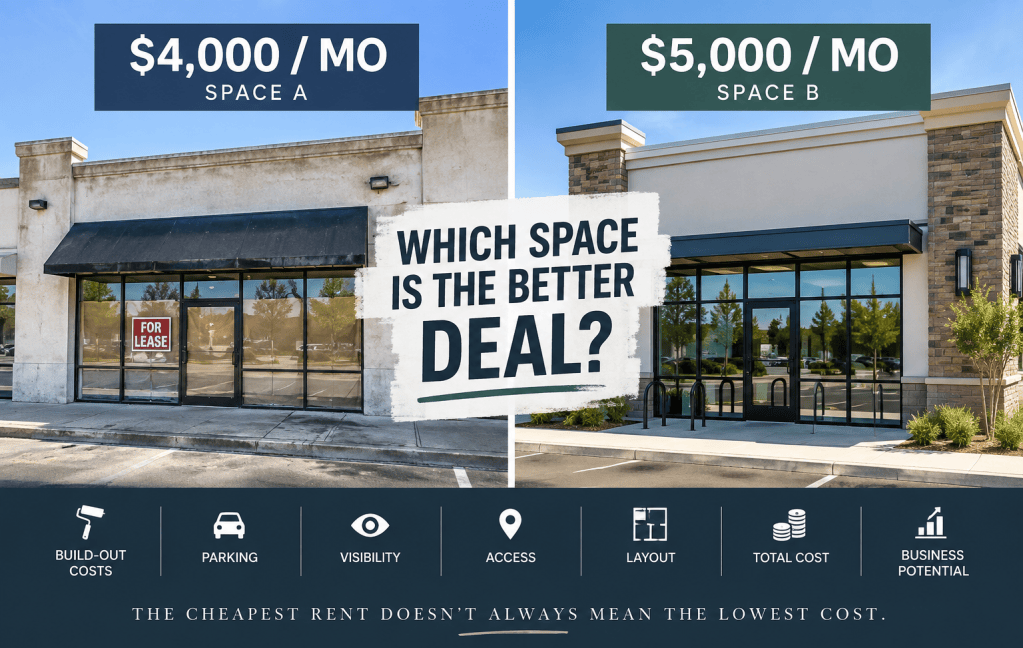
The cheapest commercial space can sometimes cost your business the most.
A property may have attractive rent because it has limitations.
That doesn’t necessarily mean you shouldn’t lease it.
The limitations may not matter to your business at all.
An appointment-only office may not care about street visibility.
An industrial user may prioritize loading and power over customer parking.
A destination retailer may be willing to trade visibility for substantially better economics.
There is no universal checklist where every property gets the same answer.
The objective is to understand:
Which characteristics actually matter to this business?
Then pay for the things that matter.
Before You Open the Door
The next time you tour commercial space, resist the urge to immediately walk inside.
Spend five minutes outside.
Look around.
Watch.
Drive the entrances.
Check the parking.
Look at the neighbors.
Stand at the street.
Find the signs.
Think like a customer.
Think like an employee.
Think like a delivery driver.
Then open the door.
You’ll walk inside with a much better understanding of the property you’re actually evaluating.
Final Thoughts
Commercial real estate isn’t just square footage behind a front door.
A business occupies an entire location.
The parking lot matters.
The street matters.
The neighboring businesses matter.
Access matters.
Visibility matters.
The surrounding area matters.
And those things can be much more difficult to change than flooring or paint.
So before you fall in love with the inside of a commercial space:
Look outside first.
Because:
You can remodel the walls. You can replace the flooring. You can change the paint. But you can’t move the parking lot.
Looking for Commercial Space in San Luis Obispo County?
If you’re considering retail, office, industrial, medical, or other commercial space in San Luis Obispo County, I can help you evaluate properties from both a real estate and business perspective.
The goal isn’t simply to find a space that looks good.
It’s to find a location that works.
Contact Rod Trujillo to discuss your commercial real estate needs.
Continue Exploring the Resource Center
The Cheapest Commercial Space Could Cost Your Business the Most
Could Your Apartment Property Be Worth More as Commercial? Let’s Run the Numbers
Tenant Representation in Commercial Real Estate: Who Is Really Representing You?
Should You Lease or Buy Commercial Property in San Luis Obispo County?
Understanding Triple Net (NNN) Leases: What Every Business Owner Should Know