By Rod Trujillo | Trujillo Commercial Real Estate Group
You’ve found a commercial property that looks like a great investment.
It’s in a desirable location.
The building looks well-maintained.
There are tenants already paying rent.
And the listing advertises an attractive return.
Sounds promising, right?
Maybe.
But here’s something I want every commercial real estate investor to understand:
A good-looking property and a good investment aren’t necessarily the same thing.
Two properties can have similar asking prices, comparable square footage, and even the same advertised cap rate.
Yet one might provide reliable income for years, while the other comes with expensive repairs, upcoming vacancies, or lease obligations that dramatically change the financial picture.
That’s why buying commercial real estate requires looking beyond the listing.
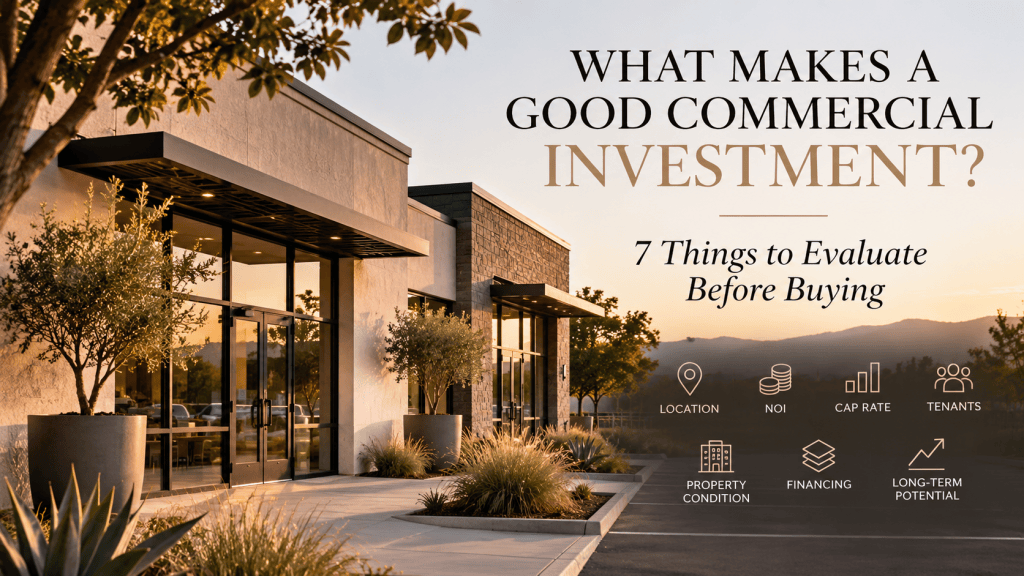
Whether you’re purchasing your first investment property or adding to an existing portfolio, here are seven things I encourage buyers to evaluate before making a decision.
1. Location: Is There Long-Term Demand for This Property?

You’ve probably heard the phrase:
Location, location, location.
It’s one of the oldest sayings in real estate.
And there’s a reason it has stuck around.
But in commercial real estate, a good location isn’t always the busiest street or the most expensive neighborhood.
A good location is one that works for the businesses that are likely to occupy the property.
Think about the difference between a retail center and an industrial warehouse.
A retail business might prioritize visibility, parking, pedestrian activity, and nearby businesses that attract customers.
An industrial tenant might care more about highway access, loading areas, truck circulation, ceiling heights, and proximity to suppliers or customers.
A medical office may prioritize convenient patient access, parking, and proximity to complementary healthcare services.
Each property type has different needs.
What Should Investors Look For?
Before purchasing, consider:
- Is the property accessible to its intended tenants and customers?
- Are nearby businesses and land uses complementary?
- Is there demand for this type of commercial space?
- Are there competing properties nearby?
- Are new developments or infrastructure changes planned?
- Does the property have characteristics that would make it difficult to lease in the future?
Think Beyond Today’s Tenant
Imagine purchasing a building occupied by a successful business.
The tenant has been there for years.
Rent is paid on time.
Everything looks great.
But what happens if that business leaves?
Would another tenant want the location?
Could the building accommodate a different business?
Or is the property’s appeal tied almost entirely to its current occupant?
The strength of a commercial location should be evaluated beyond the tenant occupying it today.
2. Net Operating Income: What Is the Property Actually Earning?
This is where the numbers become important.
One of the most common mistakes new investors make is focusing on gross rental income rather than what the property earns after operating expenses.
A building might collect $300,000 annually in rent.
That sounds impressive.
But what does it cost to operate?
Property taxes.
Insurance.
Maintenance.
Repairs.
Landscaping.
Property management.
Utilities.
Other expenses.
Those costs affect the property’s financial performance.
Understanding Net Operating Income
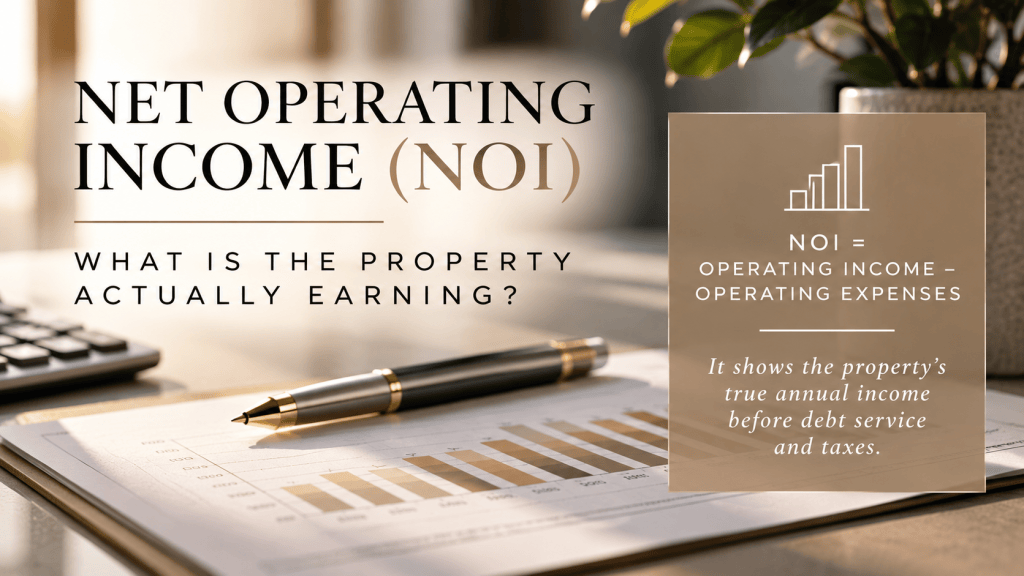
Net Operating Income, commonly called NOI, is generally calculated as:
NOI = Property Operating Income − Property Operating Expenses
NOI is calculated before debt service, income taxes, depreciation, and amortization.
Let’s Run the Numbers
Imagine you’re evaluating a small commercial investment property.
| Annual Income and Expenses | Amount |
|---|---|
| Base Rental Income | $240,000 |
| Tenant Expense Reimbursements | $60,000 |
| Total Operating Income | $300,000 |
| Property Taxes | $35,000 |
| Insurance | $12,000 |
| Maintenance and Repairs | $18,000 |
| Landscaping and Common Areas | $10,000 |
| Property Management | $15,000 |
| Utilities and Other Expenses | $10,000 |
| Total Operating Expenses | $100,000 |
| Net Operating Income | $200,000 |
In this simplified example, the property generates $200,000 in annual NOI.
But notice something important.
The building collects $300,000 in income.
It doesn’t earn $300,000 after operating expenses.
That distinction matters.
What About Triple Net Leases?
In a Triple Net, or NNN, lease, tenants typically reimburse certain operating expenses in addition to paying base rent.
That can help reduce the owner’s net expense burden.
But the actual allocation depends on the lease.
Not every NNN lease is identical, and some expenses may remain the landlord’s responsibility.
What Should You Verify?
Before buying, request and review:
- Current rent roll
- Actual rent collections
- Historical operating statements
- Property tax information
- Insurance expenses
- Maintenance and repair history
- Tenant reimbursement records
- Outstanding tenant balances
- Anticipated capital expenditures
Don’t rely solely on a marketing brochure.
The most important income figure is the one you can verify, not simply the one being advertised.
3. Cap Rate: Does the Return Make Sense for the Risk?
If you’ve looked at commercial investment listings, you’ve probably seen the term cap rate.
It’s one of the most widely used metrics in commercial real estate.
But it’s also one of the most misunderstood.
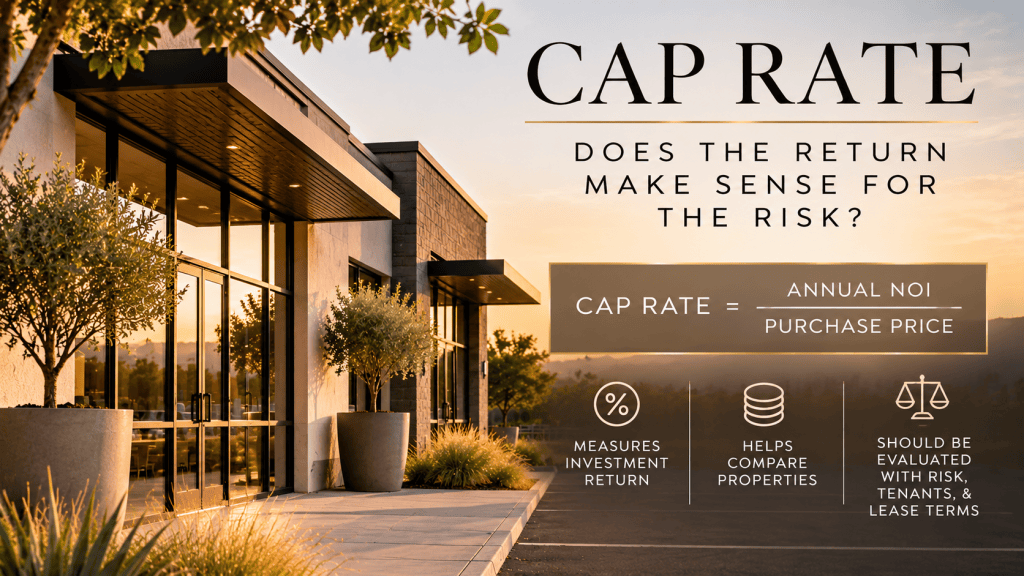
A capitalization rate, or cap rate, measures a property’s annual NOI relative to its purchase price or value.
The Formula
Cap Rate = Annual NOI ÷ Purchase Price
Let’s say you’re considering a commercial property with:
Purchase price: $2,500,000
Annual NOI: $175,000
The calculation is:
$175,000 ÷ $2,500,000 = 7.0% cap rate
That means the property’s annual NOI represents 7% of the purchase price, before financing and certain other costs.
Is a Higher Cap Rate Always Better?
Not necessarily.
Imagine two properties.
| Property A | Property B | |
|---|---|---|
| Purchase Price | $2,500,000 | $2,500,000 |
| Annual NOI | $175,000 | $137,500 |
| Cap Rate | 7.0% | 5.5% |
| Tenant Situation | Shorter leases | Longer leases |
| Property Condition | Older systems | Recently improved |
| Vacancy Risk | Potentially higher | Potentially lower |
Property A offers a higher initial cap rate.
But it may also carry greater uncertainty.
Property B produces less current NOI relative to its price, but it might offer more predictable income or lower near-term capital requirements.
The right choice depends on the investor’s goals and the risks involved.
Look Beyond the Percentage
When evaluating cap rates, ask:
Is the NOI based on actual income or projected income?
Are the tenants paying market rent?
Are operating expenses accurately represented?
Are major repairs approaching?
How does the cap rate compare with similar properties?
What would happen if a tenant moved out?
A cap rate is a useful starting point. It isn’t a complete investment analysis.
4. Tenant Quality and Lease Terms: How Reliable Is the Income?
A commercial building’s value is often closely connected to its income.
And that income depends on tenants.
Imagine two properties.
Both are fully occupied.
Both generate the same annual rental income.
Both are offered at similar prices.
But the first property has tenants with several years remaining on their leases.
The second has multiple leases expiring within the next twelve months.
Those are two very different situations.
Occupancy Doesn’t Tell the Whole Story
A property advertised as 100% occupied can still carry substantial risk.
Consider:
- How long have the tenants occupied the property?
- When do their leases expire?
- Do they have renewal options?
- Are they current on rent?
- Are their rents above or below current market levels?
- What expenses are tenants required to reimburse?
- Are there personal or corporate guarantees?
- Are there termination rights or other unusual provisions?
Watch for Lease Expiration Concentration
Suppose a commercial building has five tenants.
Three of those tenants account for 70% of the rental income.
All three leases expire within the same year.
Even though the building is currently fully occupied, a buyer should understand the potential income disruption if those tenants don’t renew.
Understand the Actual Lease
The rent roll is a helpful summary.
But it doesn’t replace reviewing the leases themselves.
Investors should examine lease agreements, amendments, renewal options, rent increases, expense reimbursements, security deposits, and other important provisions.
You’re not just buying a building. You’re buying an investment whose performance is influenced by the leases attached to it.
5. Property Condition: What Expenses Are Waiting Around the Corner?

Here’s a situation investors should be prepared for.
You purchase a commercial property.
The building looks great from the street.
The tenants are happy.
The financials appear strong.
Then, six months later, the roof needs replacement.
Or several HVAC units fail.
Or the parking lot requires major repairs.
Suddenly, your expected investment return looks very different.
Look Beyond Cosmetic Condition
Fresh paint and attractive landscaping are nice.
But they’re not a substitute for understanding the building’s major systems.
Before purchasing, investigate:
- Roof age and condition
- HVAC systems
- Plumbing and electrical systems
- Structural condition
- Parking lots and drainage
- Fire and life-safety systems
- Accessibility issues
- Deferred maintenance
- Environmental concerns
Depending on the property and transaction, professional building inspections, environmental assessments, and other specialist reviews may be appropriate.
The Difference Between Operating Expenses and Capital Expenditures
This distinction is important.
Routine landscaping and minor maintenance are typically part of normal operations.
Replacing a roof or major mechanical system may be a capital expenditure.
These costs can be significant, and they aren’t necessarily reflected in a property’s reported NOI.
A Simple Example
Suppose you purchase a property for $2.5 million.
It generates $175,000 in annual NOI.
That’s a 7% cap rate.
But the property also needs $150,000 in major improvements shortly after closing.
That additional investment affects your total capital required and your actual return.
The property’s advertised cap rate doesn’t automatically account for those costs.
A property with attractive income can become a much less attractive investment if major capital expenses haven’t been considered.
6. Financing and Cash Flow: What Will You Actually Take Home?

This is where a good property and a good investment for a particular buyer can become two different things.
Two investors can purchase the same building at the same price and experience very different financial outcomes.
Why?
Because their financing structures may be different.
One investor may purchase with cash.
Another may finance a substantial portion of the purchase price.
The building’s NOI may be identical, but their cash flow and risk will not be.
Let’s Look at an Example
Assume the following hypothetical investment:
Purchase price: $2,500,000
Annual NOI: $175,000
Down payment: $750,000
Loan amount: $1,750,000
Assume a 6.5% annual interest rate with a 25-year amortization schedule and monthly payments.
The estimated annual debt service would be approximately $141,800.
| Investment Calculation | Approximate Amount |
|---|---|
| Annual NOI | $175,000 |
| Annual Debt Service | ($141,800) |
| Annual Cash Flow Before Income Taxes | $33,200 |
That’s approximately $2,767 per month before income taxes and other costs not included in NOI or debt service.
The property still has a 7% cap rate.
But the investor’s cash flow after debt service is much smaller.
Understanding Cash-on-Cash Return
Another metric investors may consider is cash-on-cash return.
The simplified formula is:
Annual Pre-Tax Cash Flow ÷ Total Cash Invested
Using the example above, if the investor contributed only the $750,000 down payment, the simplified cash-on-cash return would be approximately 4.4%.
Actual cash invested would also include applicable closing costs, lender fees, and other upfront expenditures, potentially reducing that return.
And cash flow should be evaluated after considering appropriate reserves and anticipated capital needs.
Don’t Forget Debt Service Coverage
Lenders often examine the Debt Service Coverage Ratio, or DSCR.
DSCR = NOI ÷ Annual Debt Service
In our example:
$175,000 ÷ $141,800 = approximately 1.23
That means the property’s NOI is about 1.23 times the annual debt service.
Whether that’s sufficient depends on the lender, property type, loan terms, and other underwriting considerations.
What Should Investors Ask?
How much cash will I need to close?
What are the loan terms?
How much cash flow remains after debt service?
What happens if interest rates or expenses change?
Can the property support the loan if income declines?
Will I have adequate reserves for vacancies and repairs?
A property can look attractive on paper and still be a poor fit for your financing situation.
7. Long-Term Potential: What Happens Five or Ten Years From Now?

Commercial real estate investing isn’t only about what a property earns today.
It’s also about what the property may be worth in the future.
And future performance can be influenced by several factors.
Rental Growth
Are current rents below market levels?
Do leases include scheduled increases?
Could the property command higher rents after improvements or tenant turnover?
Potential rental growth can be valuable.
But projected increases should be supported by market evidence rather than optimism alone.
Property Improvements
Could strategic improvements make the building more attractive?
Would updating the exterior, improving signage, or modernizing common areas help attract tenants?
Could unused space be converted to a more functional layout?
The important question is whether the anticipated benefit justifies the investment.
Flexibility
A building that can accommodate several different types of tenants may offer more flexibility than one designed for a highly specialized use.
That doesn’t mean specialized properties are poor investments.
It means investors should understand the potential cost and difficulty of finding a replacement tenant.
Exit Strategy
Before purchasing, consider how you might eventually sell the property.
Who would be the likely buyer?
Would it appeal primarily to investors?
Could an owner-user purchase it?
How would the property be valued if current tenants left?
What happens if market cap rates increase?
Don’t Rely on Appreciation Alone
Property values can rise.
They can also decline.
Changes in financing costs, rental demand, operating expenses, and investor expectations can all affect value.
A strong investment should be evaluated on realistic operating performance, with future appreciation treated as a possibility rather than a guarantee.
Putting It All Together: Two Properties, Two Very Different Investments
Let’s compare two hypothetical commercial investment opportunities.
Both properties have the same asking price.
Both are currently occupied.
Both appear attractive in marketing photographs.
| Investment Factor | Property A | Property B |
|---|---|---|
| Asking Price | $3,000,000 | $3,000,000 |
| Annual NOI | $210,000 | $180,000 |
| Cap Rate | 7.0% | 6.0% |
| Lease Terms | Several near expiration | Longer remaining terms |
| Building Condition | Major repairs approaching | Recently improved |
| Tenant Mix | Concentrated income | More diversified |
| Near-Term Capital Needs | Higher | Lower |
Which is the better investment?
You might initially choose Property A.
After all, it produces $30,000 more in annual NOI.
But what if it also requires $200,000 in improvements?
What if its largest tenant leaves next year?
What if the remaining tenants are paying above-market rents?
Now Property B may look more attractive.
On the other hand, if Property A’s risks are manageable and the buyer has sufficient capital, it might offer greater upside.
There isn’t one correct answer for every investor.
The right investment depends on the price, income, risk, capital requirements, financing, and the buyer’s long-term objectives.
The Commercial Investment Property Checklist
Before moving forward with a purchase, I encourage investors to organize their due diligence around these categories.
Financial Performance
- Review the current rent roll.
- Verify historical income and collections.
- Review operating statements.
- Understand expense reimbursements.
- Calculate NOI and cap rate.
- Evaluate debt service and projected cash flow.
- Budget for vacancies and capital expenditures.
Tenants and Leases
- Review all leases and amendments.
- Confirm lease expiration dates.
- Understand renewal options.
- Evaluate tenant payment history.
- Review guarantees and security deposits.
- Identify unusual lease provisions.
- Assess tenant concentration.
Property Condition
- Inspect major building systems.
- Evaluate deferred maintenance.
- Review roof and HVAC conditions.
- Understand accessibility and safety issues.
- Consider environmental assessments.
- Estimate near-term repair and improvement costs.
Location and Market
- Research comparable rents and sales.
- Evaluate tenant demand.
- Review competing properties.
- Understand access and parking.
- Confirm zoning and permitted uses.
- Consider future leasing flexibility.
Investment Strategy
- Establish your target return.
- Understand your financing options.
- Evaluate downside scenarios.
- Plan for future capital needs.
- Consider potential exit strategies.
- Confirm the property fits your investment goals.
This checklist isn’t exhaustive. The appropriate investigation depends on the property and transaction, and buyers should work with qualified legal, financial, tax, lending, and inspection professionals.
The Biggest Mistake? Falling in Love With the Property Before Understanding the Numbers
Commercial real estate can be exciting.
You walk through a beautiful building.
You picture the rental income.
You imagine owning a property in a great location.
And it’s easy to start thinking about everything that could go right.
But good investing requires looking at what could go wrong, too.
What if a tenant leaves?
What if the roof needs replacement?
What if financing costs are higher than expected?
What if rents don’t increase as projected?
What if you need to sell sooner than planned?
Those questions aren’t reasons to avoid investing.
They’re reasons to do your homework.
The best commercial real estate decisions are made with a clear understanding of both the opportunity and the risk.
Final Thoughts
So, what makes a commercial property a good investment?
It’s not simply the building with the highest cap rate.
It’s not necessarily the newest property.
And it’s not always the one with the most recognizable tenants.
A good commercial investment is one where the property’s income, condition, location, tenant structure, financing, and long-term potential align with the buyer’s financial goals and risk tolerance.
Before purchasing, remember these seven factors:
1. Location and long-term demand
2. Net operating income
3. Cap rate and risk
4. Tenant quality and lease terms
5. Property condition and capital expenses
6. Financing and actual cash flow
7. Long-term potential and exit strategy
And above all:
Don’t buy a commercial property based on what it promises. Buy based on what you can verify, what you understand, and what makes financial sense for you.
Thinking About Investing in Commercial Real Estate on the Central Coast?
Whether you’re purchasing your first income-producing property, expanding an existing portfolio, or evaluating a commercial investment opportunity, understanding the numbers is an essential first step.
At Trujillo Commercial Real Estate Group, we work with buyers, sellers, investors, and property owners throughout San Luis Obispo County.
From retail and office properties to industrial buildings and other commercial investments, our goal is to help clients evaluate opportunities with a clear understanding of the local market and the property itself.
Contact Rod Trujillo to discuss your commercial real estate investment goals.
Rod Trujillo
Trujillo Commercial Real Estate Group
Phone: 805-439-4733
Email: rod@trujillo-group.com
Website: www.trujillo-group.com
Disclaimer: This article is intended for general educational purposes and does not constitute investment, legal, lending, or tax advice. All financial examples are hypothetical. Actual investment results depend on property-specific information, financing, market conditions, and other factors. Buyers should independently verify financial information and consult appropriate qualified professionals before purchasing commercial property.