By Rod Trujillo, Commercial Real Estate Broker
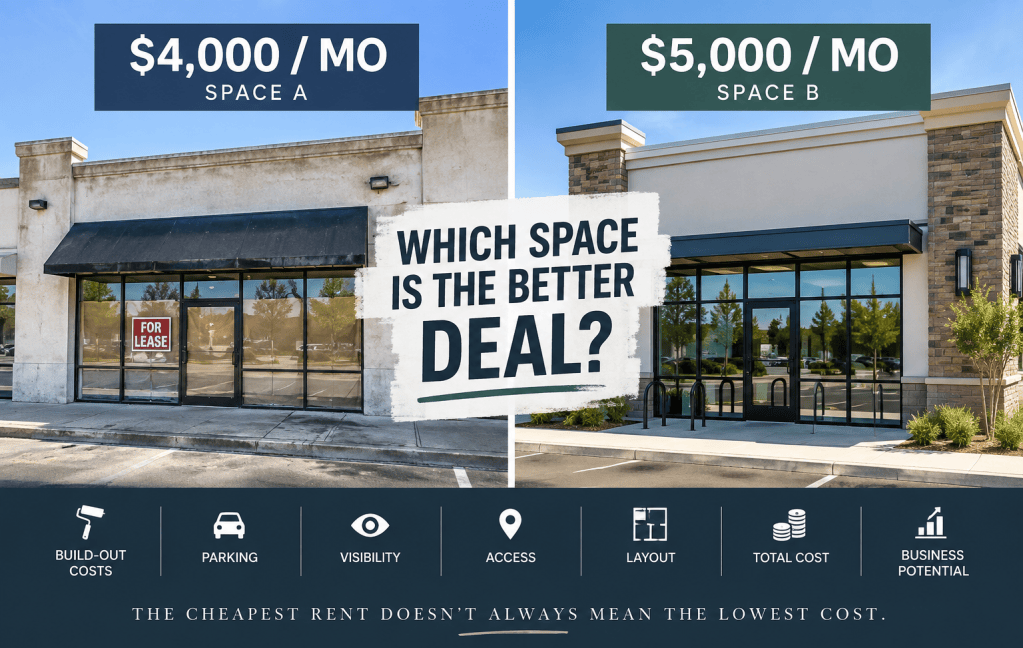
You’re looking at two commercial spaces.
Space A: $4,000 per month
Space B: $5,000 per month
At first glance, the decision seems obvious.
Space A saves you $1,000 every month.
That’s $12,000 per year.
Over a five-year lease, that’s $60,000.
So Space A is the better deal.
Right?
Not necessarily.
What if Space A needs $75,000 in improvements before you can open?
What if customers have trouble finding it?
What if the parking doesn’t work for your business?
What if the layout forces you to use more square footage than you actually need?
What if Space B is already built out, has better visibility, better access, and puts your business exactly where your customers are?
Suddenly, the $1,000 difference in monthly rent isn’t the most important number anymore.
That’s one of the biggest lessons I try to communicate to businesses looking for commercial space:
The cheapest rent does not necessarily mean the cheapest space.
Commercial real estate should be evaluated based on what a property will actually cost your business — and what it can potentially help your business accomplish.
Let’s break that down.
In This Guide
Start With the Real Question
When businesses start looking for commercial space, one of the first questions is usually:
“How much is the rent?”
It’s an important question.
But I don’t think it should be the only question.
A better question is:
“What will occupying this property actually cost my business?”
Those are two very different things.
Your rental rate is one component of your occupancy cost.
Depending on the property and lease structure, you may also need to consider:
Base rent
NNN or operating expenses
Utilities
Insurance
Maintenance responsibilities
Tenant improvements
Furniture and equipment
Signage
Permitting
Moving expenses
Parking costs
Annual rent increases
And potentially the cost of operating from a location that doesn’t work particularly well for your business.
That last category is much harder to put on a spreadsheet.
But it matters.
Let’s Compare Two Spaces
Imagine you’re a business owner choosing between two properties.
Space A
Monthly Rent: $4,000
It’s the cheaper option.
But:
The interior needs substantial work.
Parking is limited.
The building sits back from the street.
Signage isn’t particularly visible.
The entrance can be confusing for first-time customers.
And you’ll need approximately $75,000 in improvements before opening.
Space B
Monthly Rent: $5,000
That’s $1,000 more every month.
But:
The space is largely built out.
Parking is convenient.
The storefront is visible.
Customers can easily enter and exit the property.
The layout works for your operation.
And you’re much closer to being able to open the doors.
Which space is cheaper?
Now the answer isn’t so obvious.
Run the Five-Year Numbers
Let’s simplify the example.
Assume a five-year lease and ignore rent increases for the moment.
Space A
Rent:
$4,000 × 60 months = $240,000
Improvements:
$75,000
Simplified five-year total:
$315,000
Space B
Rent:
$5,000 × 60 months = $300,000
Assume only $10,000 of improvements are needed.
Simplified five-year total:
$310,000
The property with the higher monthly rent actually costs $5,000 less in this simplified example.
And we still haven’t assigned any financial value to:
Better parking
Better visibility
Faster opening
Better access
A more functional layout
Or the potential business impact of the location.
That is why comparing commercial spaces based only on asking rent can be misleading.
Tenant Improvements Can Completely Change the Deal
This is one of the biggest variables in commercial leasing.
A space may look inexpensive until you determine what it will cost to make it usable.
Depending on the business and property, improvements might include:
Walls
Flooring
Electrical work
Plumbing
HVAC
Restrooms
Lighting
Accessibility improvements
Fire and life-safety work
Kitchen or specialized equipment
Data infrastructure
Signage
Architectural plans
Permitting
Construction management
The difference between a space that is almost ready and one that needs a major build-out can easily overwhelm what initially looked like a favorable rental rate.
This doesn’t mean you should never lease unfinished space.
Sometimes an unfinished space gives you the opportunity to create exactly what your business needs.
But the improvement budget belongs in the comparison from day one.
Who Pays for the Improvements?
That depends on the transaction.
In some commercial leases, the landlord may provide a Tenant Improvement Allowance, often referred to as a TI allowance.
In others, the tenant may be responsible for most or all improvements.
There may also be situations where the landlord performs certain work before delivery.
The structure can vary substantially.
So instead of simply asking:
“How much work does this space need?”
Also ask:
“Who is paying for that work?”
A more expensive property with a meaningful landlord contribution toward improvements could potentially have better economics than a lower-rent property where the tenant pays for everything.
Parking Isn’t Just a Convenience
Parking can directly affect how well a business functions.
Think about a medical office where patients struggle to find a space.
A restaurant where customers circle the block.
A fitness studio where the parking lot is already full during peak class times.
A retailer where customers decide to keep driving because parking looks difficult.
Or an office where employees compete with customers for the same spaces.
The rental rate doesn’t capture any of that.
Before leasing, I want to understand:
How many parking spaces are available?
Are they dedicated or shared?
When is the parking lot busiest?
Are there time restrictions?
Is employee parking separate?
Is there accessible parking?
Can customers easily see where they’re supposed to park?
And most importantly:
Does the parking actually match the way your business operates?
A cheap space with the wrong parking can become very expensive operationally.
Visibility Has Value — But Not for Every Business
Some businesses depend heavily on being seen.
Retail.
Restaurants.
Coffee shops.
Salons.
Fitness concepts.
Certain medical and service businesses.
For them, visibility can contribute directly to customer awareness and convenience.
Other businesses may care much less.
A company operating primarily by appointment or serving customers off-site might not need premium street exposure.
That’s why there isn’t one universally “best” commercial location.
The question is:
What are you paying for, and does your business actually benefit from it?
If your business doesn’t need visibility, don’t automatically pay a premium for it.
But if visibility is important to customer acquisition, don’t automatically dismiss a more visible property because the rent is higher.
Access Matters More Than People Think
A property can be visible and still be difficult to access.
Maybe there’s no convenient left turn.
Maybe customers have to drive past the property and make a U-turn.
Maybe the driveway is hard to see.
Maybe entering during traffic is difficult.
Maybe delivery vehicles can’t maneuver properly.
These problems don’t appear in the rental rate.
That’s why I recommend visiting a potential location at different times of day.
Drive into it like a customer.
Leave it like a customer.
Try it during traffic.
Look at the property from both directions.
The experience of getting to the business matters.
The Layout Can Make a Smaller Space More Valuable
Square footage can also be deceptive.
Imagine two spaces that are both 2,500 square feet.
One has:
Long hallways
Awkward corners
Poorly placed restrooms
Columns in inconvenient locations
Unused storage
A strange entrance
The other has:
An efficient floor plan
Good customer flow
Useful back-of-house space
Properly located restrooms
A strong entrance
Very little wasted area
They’re technically the same size.
But operationally, they may be completely different.
Sometimes a business can function better in 2,000 efficient square feet than in 2,500 poorly configured square feet.
And if you’re paying rent by the square foot, unused space still costs money.
Think About What the Location Does for Revenue
This is where the analysis becomes more difficult — and more important.
Suppose Space B costs an additional:
$1,000 per month
That’s:
$12,000 per year
Now imagine its location helps the business generate just:
$1,500 more revenue per month
That’s:
$18,000 per year in additional revenue.
Does that automatically make Space B better?
No.
Revenue isn’t profit, and you would need to understand the actual economics of the business.
But it demonstrates the right way to think about the decision.
Commercial real estate isn’t simply an expense.
It’s part of the operating environment of the business.
The right question is not always:
“How do I minimize rent?”
Sometimes it’s:
“Which location gives this business the strongest opportunity to perform?”
Don’t Forget Triple Net Expenses
Another mistake is comparing two properties using base rent when they have different lease structures or operating expenses.
For example:
Space A might advertise:
$2.00/SF NNN
Space B:
$2.30/SF NNN
At first glance, Space A appears substantially cheaper.
But suppose Space A has estimated NNN expenses of:
$0.90/SF
while Space B has:
$0.45/SF
Your simplified monthly occupancy comparison becomes:
Space A: $2.90/SF
Space B: $2.75/SF
The “cheaper” base rent is now more expensive before you’ve even considered utilities or other obligations.
This is why I always want to know:
What is the estimated total occupancy cost?
Not just the number in the headline.
Annual Rent Increases Matter Too
Commercial leases commonly include scheduled rent increases.
Two spaces may start at similar rents but diverge significantly over the lease term.
For example, you may encounter:
Fixed annual increases
Percentage increases
Periodic increases
Adjustments tied to an index
Or other negotiated structures
The specific terms vary by lease.
When comparing proposals, don’t simply compare Month 1.
Look at the entire proposed term.
A commercial lease is a multi-year financial commitment.
Evaluate it like one.
How Soon Can You Actually Open?
This is one of the most overlooked costs.
Imagine Space A saves you $1,000 per month in rent but requires four additional months of construction.
If your business could have been operating during those four months at Space B, what did that delay cost?
Maybe nothing.
Maybe a lot.
It depends on the business.
But opening date should be part of the analysis.
For an existing company relocating, there may also be overlap between leases.
For a new business, there may be payroll, equipment financing, insurance, marketing, and other expenses occurring before revenue begins.
Time has a cost.
What Happens If You Outgrow the Space?
The cheapest location today can become very expensive if you need to move again in two years.
Before signing a lease, consider:
How quickly is the business growing?
How many employees might you have in three years?
Will inventory increase?
Could you need more customer seating?
More warehouse space?
Additional treatment rooms?
More parking?
More power?
Loading?
An expansion option?
You don’t necessarily want to lease far more space than you need today.
But you should understand whether the property has a realistic chance of supporting the business through the proposed lease term.
Moving a business is disruptive.
Doing it twice because the first location was chosen solely on price can be particularly expensive.
What About Your Employees?
Businesses often evaluate locations entirely from the customer’s perspective.
Employees matter too.
Consider:
Commute patterns
Parking
Safety
Nearby food and services
Transit or bicycle access where relevant
Work environment
Recruiting
A location that creates daily frustration for employees can have consequences that don’t show up on the lease abstract.
Again, that doesn’t mean paying more is automatically better.
It means rent is only one part of the business decision.
The Cost of the Wrong Location
Some costs are easy to calculate.
Others aren’t.
How much does poor visibility cost a retailer?
How much does inconvenient parking cost a restaurant?
How much does a bad layout cost in employee productivity?
How much does moving again cost?
How much business is lost because customers don’t like accessing the property?
These numbers can be difficult to quantify precisely.
But pretending they don’t exist doesn’t make them zero.
Commercial real estate affects how a business operates every day.
That is why choosing a property solely because it has the lowest asking rent can be a false economy.
A Better Way to Compare Commercial Spaces
When comparing properties, I would build a simple side-by-side analysis.
Look at:
Base Rent
What is the actual rent?
NNN / Operating Expenses
What additional property expenses are estimated?
Rent Increases
How does rent change over the lease term?
Tenant Improvements
How much work does the space need?
Landlord Contribution
Is there a TI allowance or landlord work?
Opening Timeline
When can the business realistically begin operating?
Parking
Does it work for customers and employees?
Visibility
Does the business benefit from exposure?
Access
How easy is the property to enter and exit?
Layout
How much of the square footage is actually useful?
Signage
Can customers find you?
Location
Does the surrounding area support the business?
Growth
Can the property accommodate the business over the lease term?
Lease Flexibility
Are there renewal, expansion, assignment, or other provisions relevant to the business?
Then ask:
Which property gives the business the best overall combination of economics, functionality, and opportunity?
That is a much better question than:
“Which one has the lowest rent?”
Sometimes the Cheapest Space Really Is the Best Choice
I don’t want to give the impression that higher rent means better real estate.
It doesn’t.
Sometimes the lower-cost property:
Has adequate parking
Has good access
Needs minimal improvements
Fits the operation perfectly
Has reasonable expenses
Provides room to grow
And saves the business money.
If that’s the case, great.
The point isn’t to avoid inexpensive space.
The point is to understand why it’s inexpensive and whether the trade-offs matter to your business.
Questions to Ask Before Choosing the Cheaper Space
Before signing because one property has the lowest rent, ask:
What will this space cost to make usable?
What are the estimated NNN or operating expenses?
What responsibilities will I have under the lease?
How much parking do I realistically need?
Does my business depend on visibility?
Can customers easily enter and exit?
Is the layout efficient?
How soon can I open?
Will the space still work three to five years from now?
What does the more expensive property give me that this one doesn’t?
And perhaps most importantly:
If I choose this space solely because it’s cheaper, what am I giving up?
Final Thoughts
Commercial real estate is one of those areas where the lowest price and the lowest cost aren’t always the same thing.
A $4,000-per-month space can cost more than a $5,000-per-month space.
A smaller space can work better than a larger one.
A higher-rent location can potentially produce better business economics.
And an inexpensive property can still be an excellent choice when its compromises don’t matter to the operation.
The goal isn’t to find the cheapest commercial space.
It’s to understand what you’re actually paying for.
Before signing a lease, look beyond the advertised rent.
Look at the improvements.
The expenses.
The parking.
The visibility.
The access.
The layout.
The timeline.
And the effect that location may have on the business.
Because sometimes:
The cheapest commercial space can become the most expensive mistake.
Looking for Commercial Space in San Luis Obispo County?
If you’re comparing commercial properties in San Luis Obispo County, I can help you evaluate more than the asking rent.
From lease economics and operating expenses to location, parking, visibility, access, and functionality, the goal is to understand how the entire property fits the needs of the business.
Contact Rod Trujillo to discuss your commercial real estate needs.
Continue Exploring the Resource Center
Could Your Apartment Property Be Worth More as Commercial? Let’s Run the Numbers.
Tenant Representation in Commercial Real Estate: Who Is Really Representing You?
Should You Lease or Buy Commercial Property in San Luis Obispo County?
Understanding Triple Net (NNN) Leases: What Every Business Owner Should Know
How to Lease Commercial Space in San Luis Obispo County: A Step-by-Step Guide