By Rod Trujillo, Commercial Real Estate Broker
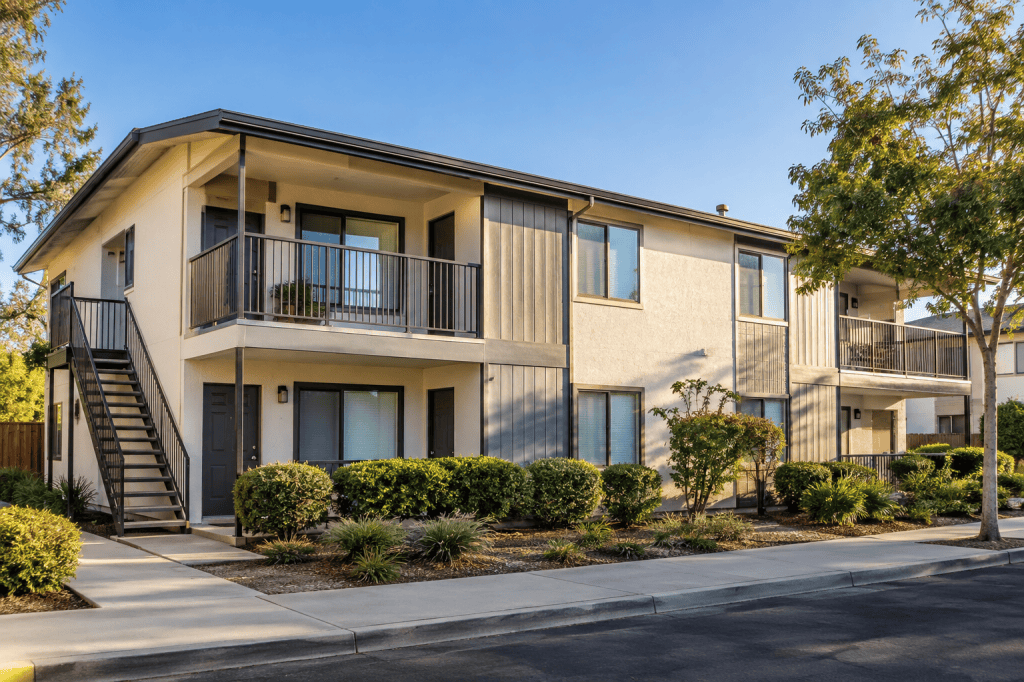
You drive past an apartment building and see apartments.
I look at the same property and sometimes find myself asking another question:
Is this the highest-value use of the property?
That does not mean every apartment building should become commercial space.
In many cases, residential use may remain the best use of the property.
But occasionally, you find a residential property in an interesting location — along a busy corridor, near professional offices, surrounded by commercial development, or in an area that has changed significantly since the property was originally built.
That is when it may be worth asking:
Could this property create more value if it were used differently?
The answer depends on much more than comparing apartment rent with office rent.
You have to look at zoning, market demand, parking, accessibility, building code, conversion costs, vacancy, operating expenses, and ultimately the income the property could realistically produce after conversion.
So rather than simply saying commercial is “better,” let’s actually run through the numbers.
In This Guide
Start With a Different Question
Property owners naturally focus on what their property is producing today.
That’s important.
But commercial real estate investors often think about another question:
What is this property capable of producing?
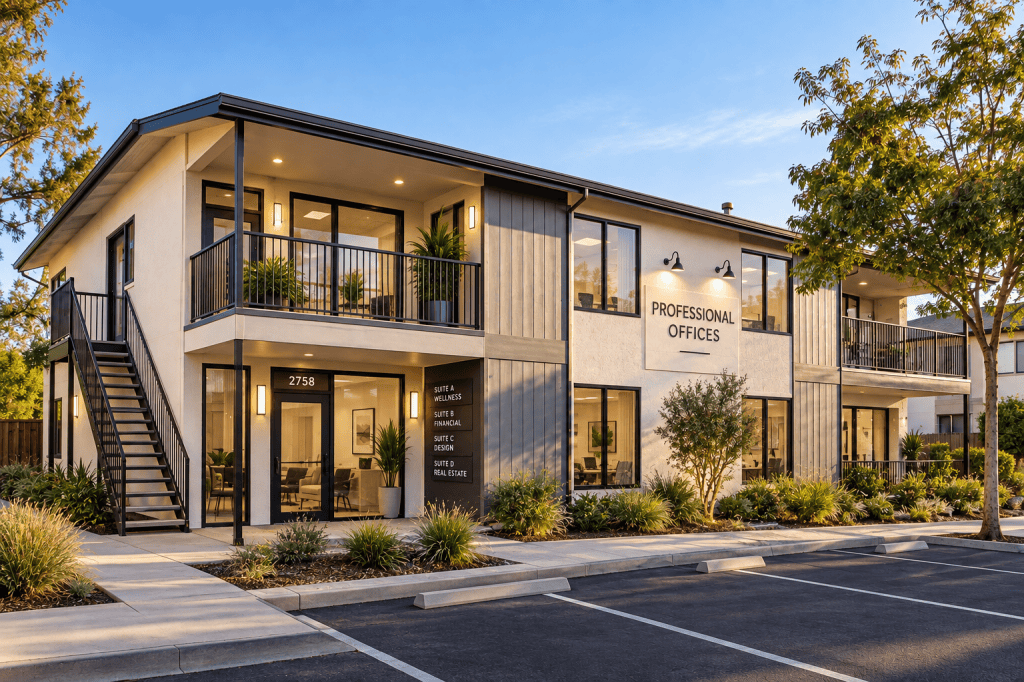
Imagine an older four-unit apartment property.
When it was built, the surrounding neighborhood may have been predominantly residential.
Decades later, perhaps the street carries significantly more traffic.
Maybe professional offices have appeared nearby.
Perhaps medical, wellness, financial, or service businesses have moved into neighboring properties.
The building hasn’t moved.
But the economics of its location may have changed.
That doesn’t mean a conversion should happen.
It means the property may deserve another look.
What Does “Highest and Best Use” Mean?
In commercial real estate and appraisal, you’ll often hear the phrase highest and best use.
In simple terms, it asks:
What legally permissible, physically possible, financially feasible use of the property produces the greatest value?
Notice the order.
Before we ask what makes the most money, we first need to know what is:
Legal.
Physically possible.
Financially feasible.
A property may look perfect for professional offices.
That doesn’t mean commercial use is permitted.
A commercial use may be permitted.
That doesn’t mean the building can economically be converted.
And a conversion may be physically possible.
That doesn’t mean tenants will pay enough rent to justify doing it.
That distinction matters.
Commercial potential does not mean commercial permission.
Why Would an Owner Consider Converting Residential Property?
There are several potential reasons.
1. Potentially Higher Income
Certain commercial uses may command higher rent than the property’s existing residential use.
But this is highly dependent on location, property quality, demand, lease structure, and the specific commercial use.
Higher commercial rent should never simply be assumed.
2. Different Lease Structures
Commercial leases can sometimes run for several years rather than shorter residential terms.
Depending on the lease, that may provide an owner with longer contractual income from a successful business tenant.
However, commercial vacancies can also take longer to fill.
3. Expense Reimbursement
Under some commercial lease structures — including certain Triple Net leases — tenants may reimburse the landlord for specified property expenses such as taxes, insurance, and common-area costs.
That can change the relationship between gross rent and the owner’s actual Net Operating Income.
4. A Different Tenant Pool
A well-positioned property could potentially appeal to professional offices, medical or wellness businesses, financial services, beauty and personal-care concepts, or other permitted commercial users.
Again, the actual possibilities depend on zoning, approvals, building configuration, and market demand.
5. Owner-User Potential
Sometimes the opportunity isn’t about becoming a commercial landlord at all.
A business owner may want to acquire a property and occupy it with their own company.
That can create a very different analysis because the property is now serving both a real estate function and a business function.
6. Repositioning an Underutilized Property
Sometimes a property’s current improvements no longer take full advantage of its location.
That is when redevelopment or repositioning becomes worth investigating.
Let’s Run a Hypothetical San Luis Obispo Example
Consider a hypothetical older apartment property in San Luis Obispo.
Assume it contains:
4 two-bedroom apartments
Approximately 900 square feet each
Approximately 3,600 square feet total
For illustration, let’s assume each apartment rents for:
$2,750 per month
That gives us:
4 × $2,750 = $11,000 per month
Or:
$132,000 in annual gross residential rent
Now let’s imagine the property’s zoning, approvals, physical characteristics, and location could potentially support commercial use.
What happens if we convert it?
Scenario 1: Ordinary Office Rent
Assume the converted property could lease for:
$2.50 per square foot per month
At 3,600 square feet:
3,600 SF × $2.50 = $9,000 per month
Annual gross rent:
$108,000
Compare that with the apartments:
Residential: $132,000/year
Commercial: $108,000/year
Difference:
Commercial produces $24,000 LESS gross rent per year.
That’s an important lesson.
Commercial doesn’t automatically mean more profitable.
In this scenario, based solely on gross rent, I would have very little reason to pursue an expensive conversion.
Scenario 2: Stronger Commercial Rent
Now assume the property’s location and quality could support:
$3.25/SF/month
The calculation becomes:
3,600 × $3.25 = $11,700/month
Annual gross commercial rent:
$140,400
Now compare:
Residential: $132,000
Commercial: $140,400
Potential increase:
$8,400 per year
That’s approximately a 6.4% increase in gross income.
Better?
Yes.
Enough to justify a major conversion?
Not necessarily.
We haven’t considered conversion costs, vacancy, financing, leasing expenses, or operating costs yet.
Scenario 3: Premium Commercial Use
Now let’s test a stronger scenario.
Suppose an appropriate commercial tenant would realistically pay:
$3.50/SF/month
Then:
3,600 × $3.50 = $12,600/month
Annual gross commercial rent:
$151,200
Our comparison becomes:
| Scenario | Monthly Gross | Annual Gross |
|---|---|---|
| Existing Residential | $11,000 | $132,000 |
| Commercial @ $2.50/SF | $9,000 | $108,000 |
| Commercial @ $3.25/SF | $11,700 | $140,400 |
| Commercial @ $3.50/SF | $12,600 | $151,200 |
At $3.50/SF, the commercial scenario produces:
$19,200 more gross income per year
That’s approximately 14.5% more gross income than our hypothetical residential scenario.
Now we have something worth investigating.
But we still don’t know if we have a good deal.
Now Add the Conversion Cost
This is where property owners need to be careful.
Changing a residential property into commercial space can involve much more than removing a kitchen and adding a sign.
Depending on the project, costs might include:
- Architecture and engineering
- Planning and entitlement work
- Building permits
- Accessibility improvements
- Restroom modifications
- Fire and life-safety improvements
- Electrical upgrades
- HVAC modifications
- Interior construction
- Exterior improvements
- Parking and site work
- Signage
- Landscaping
- Utility changes
- Financing costs
- Professional fees
- Lost income during construction
- Leasing costs
- Tenant improvements
For our example, let’s make a purely illustrative assumption that the total project costs $400,000.
This is not a construction estimate. Actual costs would need to be determined by appropriate contractors and professionals for the specific property.
Our premium commercial scenario generated an additional:
$19,200/year in gross rent
If the only benefit of spending $400,000 were that additional gross rent:
$400,000 ÷ $19,200 ≈ 20.8 years
That’s a very long simple payback period.
Suddenly, the conversion doesn’t look nearly as exciting.
This is why I would never recommend evaluating one of these projects based on:
“Commercial rents are higher.”
The real question is:
After the cost, risk, vacancy, expenses, and time involved, did we actually create value?
Gross Rent Is Not the Number That Matters Most
Property owners should also look at Net Operating Income, commonly called NOI.
NOI is essentially the income produced by a property after certain operating expenses, but before items such as debt service and income taxes.
Why does that matter?
Because two properties can collect the same gross rent and leave their owners with very different amounts of income.
A commercial lease structure may shift certain expenses to tenants.
A residential landlord may be responsible for a different set of expenses.
The comparison should therefore eventually become:
Residential NOI
versus
Potential Commercial NOI
—not simply residential rent versus commercial rent.
How Increased NOI Can Affect Value
Commercial investment property is often evaluated partly based on its Net Operating Income and the capitalization rate investors require for comparable properties.
A simplified valuation formula is:
Value = NOI ÷ Capitalization Rate
Here’s a hypothetical example.
Suppose repositioning a property ultimately increased sustainable NOI by:
$30,000 per year
And suppose comparable investors were valuing that type of income at a hypothetical:
6.5% capitalization rate
Mathematically:
$30,000 ÷ 0.065 ≈ $461,538
That illustrates approximately $462,000 of indicated incremental value associated with the additional NOI, assuming everything else were equal.
That is not an appraisal, and real-world cap rates and values vary significantly.
But it illustrates why commercial property owners care about NOI.
A conversion may be interesting not simply because it produces more monthly rent, but because it potentially changes the property’s income stream and valuation profile.
Where Commercial Conversion Can Become More Interesting
The strongest opportunities may have several characteristics working together.
The Location Has Become More Commercial
A property on a major corridor surrounded by businesses may deserve a different analysis than a similar apartment building deep inside a residential neighborhood.
The Property Has Strong Visibility
Commercial tenants may place value on traffic exposure, signage, accessibility, and customer convenience.
Parking Works
Parking can make or break a commercial conversion.
A building may have plenty of parking for residential use and still fall short for a proposed commercial use.
The Layout Is Adaptable
A property that can reasonably accommodate offices, treatment rooms, reception, restrooms, and customer circulation may be easier to reposition than one requiring extensive structural work.
There Is Proven Commercial Demand
This may be the most important factor.
Higher theoretical rent means nothing if nobody wants to lease the space.
Before converting, understand what businesses are actually looking for in that location.
The Owner-User Scenario
This is where the analysis can become especially interesting.
Imagine a professional practice needs approximately 3,500 square feet.
Instead of leasing commercial space somewhere else, the business owner acquires an appropriately located property that can legally and economically be converted.
Now the analysis isn’t simply:
Apartment rent vs. office rent.
It may involve:
- Control of the business location
- Long-term occupancy
- Building equity
- Customizing the property
- Potential future rental income
- Separating the real estate from the operating business
- Long-term investment or retirement strategy
That is a fundamentally different decision from converting apartments simply because you think office rent might be higher.
Zoning Comes First
Before calculating potential commercial rent, determine whether the proposed use is allowed.
The City of San Luis Obispo specifically advises new businesses to confirm with Planning that a proposed business is allowed in the applicable zone before signing a lease.
For a property owner considering a conversion, the same principle applies:
Understand the zoning before spending money designing the conversion.
Depending on the property and proposed use, the process could involve zoning review, use permits, a change in occupancy, building permits, or potentially more significant land-use approvals.
San Luis Obispo’s own public records show that changes between residential, mixed-use, and commercial development can involve formal use permits or even zoning/general-plan changes depending on the property and proposal.
The fact that a property would make a great office doesn’t mean you’re allowed to use it as one.
Parking Can Change the Entire Deal
Parking is one of the first physical issues I would investigate.
Different uses can create different parking requirements.
San Luis Obispo’s zoning regulations specifically address parking requirements by use and situations where a change in occupancy increases required parking.
A property might have:
Excellent visibility
A great building
Strong commercial demand
Attractive potential rent
—and still fail the feasibility test because the intended use cannot satisfy parking or other site requirements.
This is why the physical property and the business use have to be evaluated together.
Accessibility, Building Code, and Improvements
A change from residential to commercial occupancy may also raise building and accessibility issues.
Depending on the specific property and proposed use, you may need to investigate:
- Accessible entrances
- Accessible paths of travel
- Restrooms
- Door widths
- Fire and life-safety systems
- Occupancy classifications
- Electrical capacity
- HVAC
- Structural modifications
- Signage
- Site circulation
These are questions for qualified architects, engineers, contractors, building officials, and other appropriate professionals.
The earlier you identify them, the better.
A $100,000 idea can become a $500,000 project surprisingly quickly if major building upgrades are required.
Don’t Forget the Income You Lose During Conversion
Suppose the apartments currently generate $11,000 per month.
If they need to be vacant for six months while the project goes through construction and leasing:
6 × $11,000 = $66,000
That’s $66,000 of foregone gross residential rent before considering other carrying costs.
And six months may or may not be realistic for a particular project.
Planning, approvals, construction, and commercial leasing all take time.
Downtime belongs in the feasibility analysis.
Commercial Vacancy Can Be Different
Residential and commercial leasing behave differently.
A well-priced apartment in a strong rental market may lease relatively quickly.
A specialized commercial property may take considerably longer to find the right tenant.
And once a commercial tenant leaves, the next tenant may require:
- Different improvements
- New signage
- Additional permitting
- A tenant improvement allowance
- Free rent
- Broker commissions
- Months of vacancy
Longer commercial lease terms can be attractive.
But longer potential vacancy periods are the other side of that equation.
The Seven Questions I Would Ask Before Converting
If an owner asked me whether a residential property should be converted to commercial use, I would work through these questions in order.
1. Is the proposed use legally allowed?
Start with zoning and land-use regulations.
2. Is there real demand?
What businesses actually want space in this location?
3. What rent can the property realistically achieve?
Not the highest asking rent you’ve seen online.
Realistic rent for this specific property.
4. What will the conversion actually cost?
Get real numbers from qualified professionals.
5. What will the property actually earn?
Calculate realistic occupancy, expenses, vacancy, and leasing costs.
6. What happens to NOI?
Compare the property’s existing NOI with its projected stabilized NOI.
7. Did we create enough value to justify the risk?
Only then do we have the information needed for a meaningful decision.
When Conversion May Be Worth Investigating
A residential-to-commercial conversion may deserve closer analysis when:
- The property is in or near an established commercial area
- The existing use appears underutilized relative to the location
- Commercial use is legally feasible
- Parking and access can support the intended use
- The building can be adapted economically
- There is proven tenant or owner-user demand
- Commercial NOI could materially exceed existing NOI
- The conversion may improve the property’s long-term flexibility
- An owner-user has a strategic reason to occupy the property
- The potential increase in value justifies the conversion cost and risk
When I Would Be Cautious
I would be much more cautious when:
- Residential income is already very strong
- Commercial rent is only slightly higher
- The property requires expensive structural or accessibility work
- Parking is inadequate
- Zoning is uncertain
- The commercial use is highly specialized
- Tenant demand is weak
- The project requires significant downtime
- The owner is relying on optimistic rent assumptions
- The conversion only works if everything goes perfectly
A good investment should not require every assumption to land at the best possible outcome.
The Biggest Mistake: Assuming Different Means Better
Changing the use of a property can feel like you’re “unlocking” value.
Sometimes you are.
Sometimes you’re simply spending a great deal of money to produce a different type of income.
That’s why I like to run the numbers before falling in love with the concept.
In our hypothetical example:
At $2.50/SF commercial rent?
I wouldn’t be excited.
At $3.25/SF?
I’d investigate further, but the additional gross income alone probably wouldn’t justify a major conversion.
At $3.50/SF?
Now I’m interested enough to study the deal — but I still need conversion costs, vacancy assumptions, operating expenses, market demand, and projected NOI.
That’s what commercial real estate analysis is supposed to do.
Not prove that an idea works.
Determine whether it works.
Final Thoughts
Sometimes the most valuable question you can ask about a property isn’t:
“What is it worth?”
It’s:
“What else could it become?”
An apartment property may remain most valuable as apartments.
Another property may have characteristics that make professional, medical, mixed-use, owner-user, or another permitted commercial strategy worth investigating.
The opportunity isn’t simply converting residential space into commercial space.
The opportunity is recognizing when the location, market, zoning, building, and economics have aligned to make another use worth considering.
Before asking what the property could earn, determine what the property is legally and physically capable of becoming.
Then run the numbers.
Because:
Sometimes the most valuable thing about a property isn’t what it is today. It’s what it could become.
Wondering Whether Your Property Has Commercial Potential?
If you own a property in San Luis Obispo County and you’re wondering whether its current use is still its best use, I can help you look at the commercial real estate side of the equation — location, market demand, potential rents, comparable commercial properties, and possible repositioning strategies.
From there, qualified planning, legal, architectural, construction, tax, and financial professionals can help determine whether a particular conversion is legally, physically, and financially feasible.
Contact Rod Trujillo to discuss your commercial real estate goals.
Continue Exploring the Resource Center
Tenant Representation in Commercial Real Estate: Who Is Really Representing You?
Should You Lease or Buy Commercial Property in San Luis Obispo County?
Understanding Triple Net (NNN) Leases: What Every Business Owner Should Know
How to Lease Commercial Space in San Luis Obispo County: A Step-by-Step Guide
The Complete Guide to Commercial Real Estate in San Luis Obispo County