By Rod Trujillo, Commercial Real Estate Broker
Leasing Commercial Space Is About More Than Finding an Empty Building
For many business owners, leasing commercial space is one of the largest financial commitments they will make. Whether you are opening your first retail store, relocating an office, expanding your company, or leasing warehouse space, the decisions you make before signing a lease can have a lasting effect on your business.
In San Luis Obispo County, every community has its own business environment. A storefront in downtown San Luis Obispo serves a different customer base than one in Paso Robles. Industrial space in Atascadero may have different operational requirements than office space in Arroyo Grande. Understanding those differences is just as important as understanding the lease itself.
After more than 25 years in commercial real estate, I have learned that successful leases begin with preparation. The goal is not simply to find available space. It is to find the right space—one that supports your business today and provides flexibility for tomorrow.
This guide walks through the commercial leasing process step by step so you can approach your next lease with greater confidence.
In This Guide
- Leasing Commercial Space Is About More Than Finding an Empty Building
- In This Guide
- Step 1: Define Your Business Needs
- Step 2: Choose the Right Location
- Step 3: Understand Commercial Lease Types
- Step 4: Determine Your Total Occupancy Budget
- Step 5: Evaluate the Property Carefully
- Step 6: Confirm Zoning and Permitted Use
- Step 7: Negotiate the Lease
- Step 8: Understand Tenant Improvements
- Step 9: Plan for Future Growth
- Common Commercial Leasing Mistakes
- Frequently Asked Questions
- Related Resources
- Final Thoughts
- Ready to Find the Right Commercial Space?
Step 1: Define Your Business Needs
Before you begin touring properties, take time to identify what your business truly requires.
Consider the following questions:
- How much space do you need today?
- Will your business grow over the next three to five years?
- Do customers regularly visit your location?
- How many employees need workspace?
- Do you need storage, warehouse space, or a loading area?
- Is convenient parking essential?
- Do you require specialized power, ventilation, internet, or plumbing?
- Will you need room to expand?
- Does your business need visibility from a major road?
- Are there specific accessibility requirements?
Having clear answers will help narrow your search and prevent you from paying for space you do not need—or outgrowing the property too quickly.
Create Two Lists
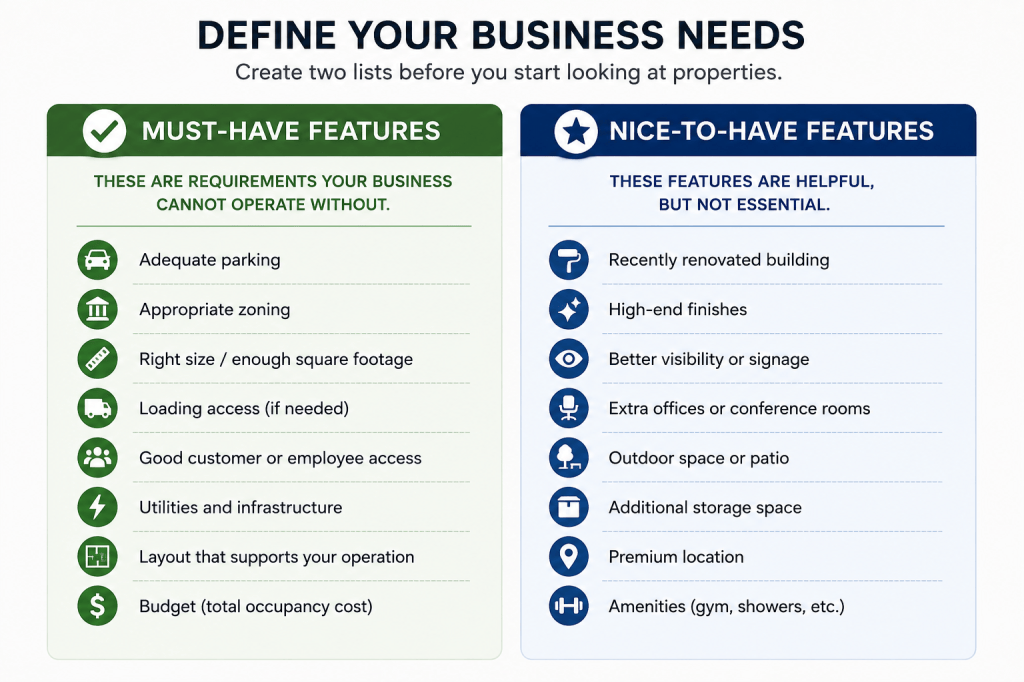
Before touring properties, prepare:
Must-have features
These are requirements your business cannot operate without, such as adequate parking, appropriate zoning, loading access, or a minimum ceiling height.
Nice-to-have features
These are helpful but not essential, such as a newly renovated lobby, additional conference rooms, or premium visibility.
Separating needs from preferences will make it easier to compare properties objectively.
Step 2: Choose the Right Location
Location is one of the most important decisions you will make.
The right location depends on your customers, employees, operations, and long-term business plan.

Retail Businesses
Retail businesses often benefit from:
- High visibility
- Strong traffic counts
- Convenient parking
- Easy customer access
- Nearby complementary businesses
- Attractive signage opportunities
- Demographics that match the customer base
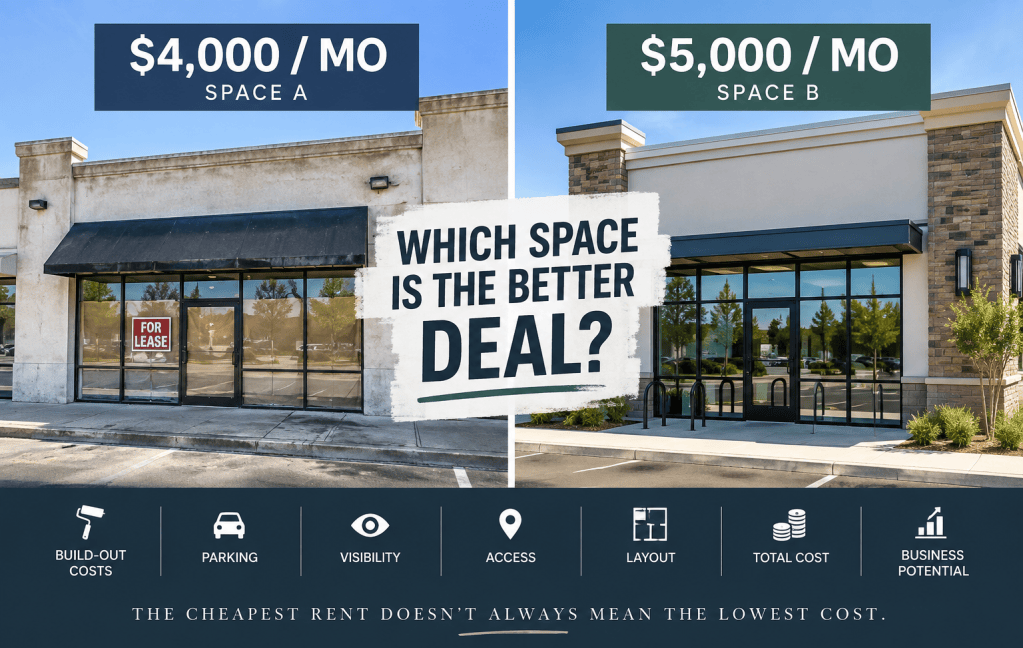
A lower-cost storefront may not provide good value if customers cannot easily find it or access it.
Office Users
Professional offices often prioritize:
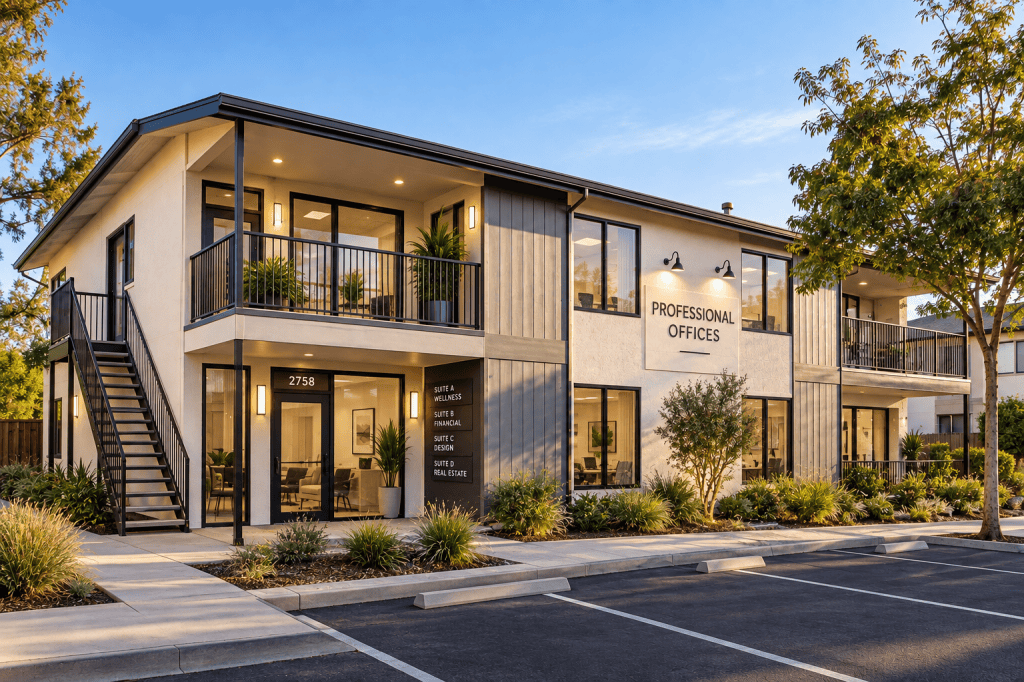
- A professional building appearance
- Convenient parking
- Accessibility
- Reliable internet
- Flexible floor plans
- Meeting and collaboration space
- Proximity to clients or referral partners
An efficient layout may be more valuable than simply leasing the largest available office.
Industrial Businesses
Industrial users frequently focus on:
- Truck access
- Loading docks or grade-level doors
- Ceiling height
- Yard space
- Electrical capacity
- Ventilation
- Warehouse configuration
- Appropriate zoning
- Access to major transportation routes
The building must support the actual operation of the business, not just provide enough square footage.
Local Market Considerations
Different communities within San Luis Obispo County offer different advantages.
Downtown San Luis Obispo may work well for professional services, restaurants, and boutique retail. Paso Robles may offer opportunities connected to wine, hospitality, manufacturing, and tourism. Atascadero can be attractive for industrial, service, and expanding businesses because of its central location. South County communities such as Arroyo Grande, Grover Beach, Nipomo, and Pismo Beach each serve distinct customer bases and industries.
Matching your business model to the right community is just as important as selecting the right building.
Step 3: Understand Commercial Lease Types
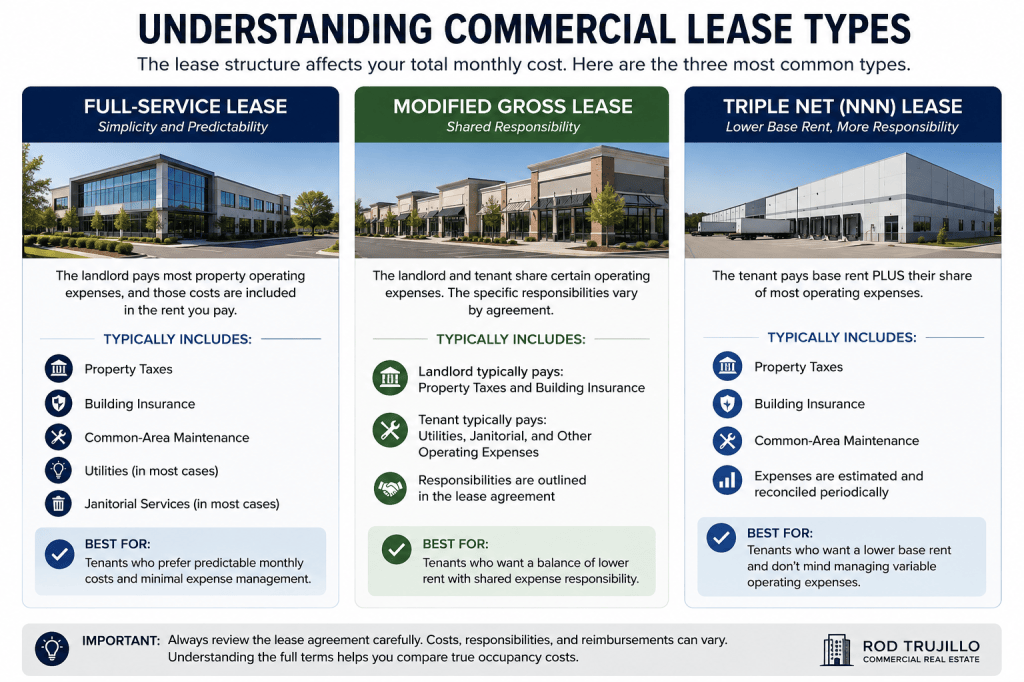
Commercial leases are not all structured the same way.
The lease structure affects your true monthly cost, so it is important to understand what is included in the advertised rent.
Full-Service Lease
In a full-service lease, the landlord typically pays many property operating expenses, and those costs are included in the rent.
Depending on the agreement, this may include:
- Property taxes
- Building insurance
- Common-area maintenance
- Utilities
- Janitorial services
The lease should clearly explain which expenses are included and whether the landlord can pass through future increases.
Modified Gross Lease
A modified gross lease divides operating expenses between the landlord and tenant.
For example, the landlord may pay property taxes and insurance while the tenant pays utilities and janitorial costs.
Because these agreements vary, the responsibilities of each party should be clearly defined.
Triple Net Lease
In a Triple Net, or NNN, lease, the tenant typically pays base rent plus a share of:
- Property taxes
- Building insurance
- Common-area maintenance
These additional charges are often estimated and reconciled periodically.
A property with a lower base rent may not necessarily have a lower total occupancy cost once NNN expenses are included.
Step 4: Determine Your Total Occupancy Budget
Base rent is only one part of the cost of leasing commercial space.
Additional costs may include:
- Common-area maintenance charges
- Property tax and insurance reimbursements
- Utilities
- Internet and telephone service
- Janitorial service
- Business insurance
- Security deposits
- Signage
- Furniture and equipment
- Tenant improvements
- Permits and professional fees
- Moving costs
- Equipment installation
- Maintenance and repair obligations
When comparing properties, request an estimate of the total monthly occupancy cost.
Two spaces with similar base rents may have very different overall expenses.
Budget Planning Tip
Build a contingency into your budget for unexpected costs. Construction delays, permit requirements, utility upgrades, and equipment installation can all affect the final amount needed to open the space.
Step 5: Evaluate the Property Carefully
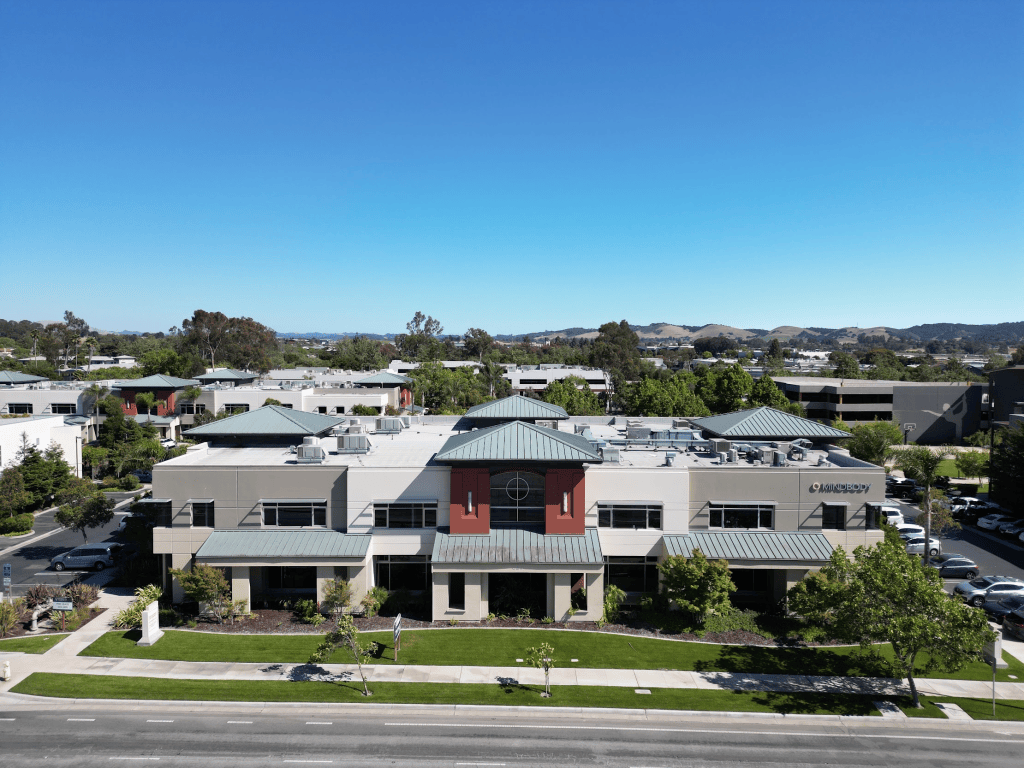
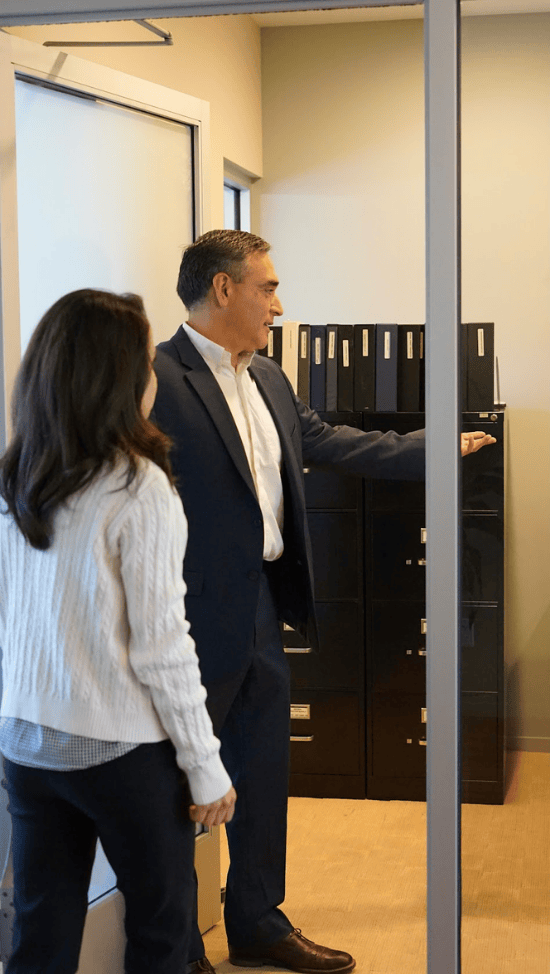
When touring commercial properties, look beyond appearance.
Consider the following:
- Is the building easy to find?
- Is there sufficient parking?
- Does the floor plan fit your operation?
- Are the restrooms adequate?
- Is the heating and air-conditioning system in good condition?
- Is the property accessible?
- Is the electrical capacity sufficient?
- Are neighboring businesses a good fit?
- Is signage visible and permitted?
- Are deliveries and loading convenient?
- Does the property make a positive impression?
- Are there signs of deferred maintenance?
Sometimes a smaller space in a stronger location offers more long-term value than a larger property in the wrong area.
Tour the Property at Different Times
A property may feel very different during the morning commute, lunchtime, evenings, or weekends.
Visiting more than once can help you evaluate:
- Parking availability
- Traffic patterns
- Noise
- Neighboring activity
- Customer accessibility
- Lighting and security
Step 6: Confirm Zoning and Permitted Use
Never assume a business can legally operate in a space simply because a similar business was there before.
Before signing a lease, confirm that the property’s zoning and use regulations support your intended operation.
Questions may include:
- Is the proposed use permitted?
- Is a conditional-use permit required?
- Are there parking requirements?
- Are there restrictions on signage?
- Will the business need health, fire, or building approvals?
- Are planned improvements allowed?
- Are there restrictions on operating hours, noise, or outdoor storage?
Local agencies may require permits or approvals before the business can open.
The lease should address what happens if required approvals cannot be obtained.
Step 7: Negotiate the Lease
Many business owners do not realize that commercial leases are negotiable.
Commonly negotiated terms include:
- Base rent
- Rent increases
- Lease term
- Renewal options
- Security deposit
- Tenant improvement allowance
- Free-rent periods
- Maintenance responsibilities
- Signage rights
- Parking rights
- Expansion options
- Assignment and subleasing
- Exclusivity provisions
- Personal guarantees
- Early termination rights
The most important term is not always the rental rate. A small change to renewal rights, maintenance responsibilities, or rent increases can have a significant financial impact over the life of the lease.
Review the Entire Agreement
Commercial leases can be lengthy and detailed. The document may contain provisions affecting insurance, repairs, indemnity, default, relocation, operating expenses, and future rent.
Consider having appropriate legal and financial professionals review the agreement before signing.
Step 8: Understand Tenant Improvements
Many commercial spaces require changes before a business can operate.
Tenant improvements may include:
- Interior walls
- Flooring
- Lighting
- Plumbing
- Electrical upgrades
- HVAC modifications
- Restroom improvements
- Accessibility work
- Signage
- Specialized equipment
The lease should clearly state:
- Who pays for the work
- Who manages construction
- Who approves the plans
- Whether the landlord provides an allowance
- When rent begins
- Who owns the improvements
- What must be removed at the end of the lease
Construction and permitting often take longer than expected, so build adequate time into the schedule.
Step 9: Plan for Future Growth

Think beyond your immediate needs.
Ask:
- Can the business expand within the property?
- Is adjacent space likely to become available?
- Is there an option to renew?
- How will rent change during a renewal?
- Can the lease be assigned if the business is sold?
- Can the space be subleased?
- What happens if the business outgrows the location?
- Are there personal guarantee obligations?
Planning for future changes can reduce costly relocations and business interruptions.
Common Commercial Leasing Mistakes
Many leasing problems can be avoided with preparation.
Choosing Space Based Only on Price
- The lowest rent does not always provide the best value.
- A space with poor visibility, insufficient parking, or a difficult layout may cost more in lost business and operational inefficiency.
Focusing Only on Base Rent
- Base rent does not show the full financial commitment.
- Always evaluate operating expenses, utilities, repairs, construction, insurance, and other occupancy costs.
Failing to Confirm Permitted Use
- A lease may be signed before the tenant discovers that the business requires additional approvals or cannot operate as planned.
- Confirm zoning and use requirements early.
Underestimating Improvement Costs
- Even a space that appears nearly ready may require permits, accessibility work, electrical upgrades, or specialized construction.
- Obtain realistic estimates before committing.
Ignoring Maintenance Responsibilities
- The lease may make the tenant responsible for heating and air conditioning, plumbing, roofing, glass, or other building systems.
- Understand these obligations before signing.
Not Planning for Growth
- A business may outgrow a space before the lease ends.
- Review expansion, assignment, subleasing, and renewal options before committing to a long-term agreement.
Waiting Until the Last Minute
- Finding and preparing commercial space often takes longer than expected.
- Starting early provides more choices, time for due diligence, and stronger negotiating flexibility.
Frequently Asked Questions
How long are commercial leases?
- Many commercial leases range from one to ten years, but the appropriate term depends on the property, tenant improvements, business stability, and long-term goals.
- A shorter term may provide flexibility, while a longer term may provide greater stability and justify a larger investment in improvements.
What is a Triple Net lease?
- A Triple Net lease generally requires the tenant to pay base rent plus a share of property taxes, building insurance, and common-area maintenance.
- The exact expenses should be clearly described in the lease.
Can commercial lease terms be negotiated?
- Yes. Many provisions may be negotiable, including rent, lease length, renewal options, tenant improvements, signage, parking, and maintenance responsibilities.
- Negotiating leverage depends on the property, market conditions, tenant qualifications, and proposed lease terms.
How much commercial space do I need?
- The answer depends on your industry, employees, equipment, customers, storage requirements, and growth plans.
- A space-planning professional may help businesses with more complex needs.
How far in advance should I begin looking?
- Many businesses should begin several months before their desired opening or move date. More complicated projects involving permits, construction, financing, or specialized equipment may require significantly more time.
Should I work with a commercial real estate broker?
- A commercial broker can help identify properties, compare locations, explain lease structures, coordinate negotiations, and guide the transaction process.
- The value of representation is often greatest before a property or lease has already been selected.
Related Resources
Continue exploring the San Luis Obispo Commercial Real Estate Resource Center:
- The Complete Guide to Commercial Real Estate in San Luis Obispo County
- Understanding Triple Net Leases (coming soon)
- Tenant Representation vs. Landlord Representation (coming soon)
- Should You Lease or Buy Commercial Property? (coming soon)
- How to Choose the Right Location for Your Business (coming soon)
Final Thoughts
Leasing commercial space is one of the most important decisions a business owner can make.
The right property and lease structure can support long-term growth. The wrong decision can create unnecessary expense, operational challenges, and limited flexibility.
Taking time to define your needs, understand your total costs, evaluate the property, confirm permitted use, and negotiate carefully can help you make a more informed decision.
Ready to Find the Right Commercial Space?
Whether you are opening your first storefront, relocating an office, expanding into industrial space, or evaluating multiple locations, finding the right commercial property requires more than simply searching available listings.
If you are considering leasing commercial property anywhere in San Luis Obispo County, I would be happy to discuss your goals and help you evaluate available opportunities.
Contact Rod Trujillo today to discuss your commercial real estate needs.
About Rod Trujillo

Rod Trujillo has more than 25 years of experience helping businesses, investors, landlords, and property owners navigate commercial real estate throughout San Luis Obispo County and California’s Central Coast.
Through the San Luis Obispo Commercial Real Estate Resource Center, Rod shares practical, educational resources designed to help readers make informed decisions about leasing, buying, selling, and investing in commercial real estate.