By Rod Trujillo | Trujillo Commercial Real Estate Group
When people think about growing their commercial real estate portfolio, they often think about buying another property.
Another shopping center.
Another office building.
Another warehouse.
But what if one of your best investment opportunities is a property you already own?
Sometimes, increasing the value of commercial real estate doesn’t require purchasing another building. It requires taking a closer look at how your existing property operates.
Could the building generate more income?
Are there improvements that would make it more attractive to tenants?
Could better lease structures, property management, or strategic upgrades improve its long-term performance?
These are questions worth asking.
Because in commercial real estate, creating value isn’t always about owning more. Sometimes it’s about making more of what you already own.
Here are five ways property owners can potentially increase the value of their commercial investments.
1. Increase Rental Income Strategically
One of the most direct ways to improve a commercial property’s financial performance is to evaluate its rental income.
That doesn’t mean automatically raising every tenant’s rent.
It means understanding what the market supports and identifying opportunities to improve income over time.
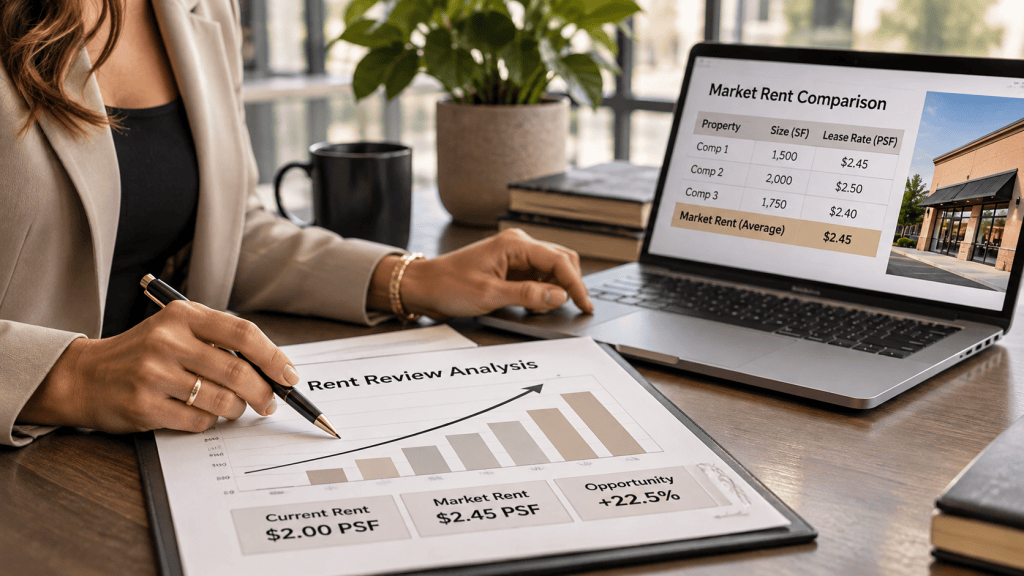
Start With a Market Rent Review
Imagine you own a small commercial shopping center in San Luis Obispo County.
Several tenants have occupied their spaces for years.
They’ve been reliable, and you have a good working relationship.
But their rental rates may no longer reflect current market conditions.
Before making changes, consider:
- What are comparable properties charging?
- Are the spaces similar in size, condition, and location?
- Are tenants paying base rent plus operating expenses?
- Do the leases contain scheduled increases?
- When do the leases expire?
- What renewal options do the tenants have?
A market rent review can help owners understand whether there is room for improvement.
Of course, existing lease agreements govern when and how rent can change. Market rents may also be lower than current rents, depending on the property and market.
Let’s Look at the Numbers
Suppose a commercial property has 10,000 square feet of rentable space.
The average base rent is $2.00 per square foot per month.
That generates:
10,000 SF × $2.00 = $20,000 per month
Or:
$240,000 annually in scheduled base rent.
Now imagine that over time, through negotiated renewals and new leases, the average rental rate increases to $2.15 per square foot per month.
The new scheduled rental income would be:
10,000 SF × $2.15 = $21,500 per month
Or:
$258,000 annually.
That’s an increase of:
$18,000 in annual scheduled base rental income.
If that entire increase flowed through to Net Operating Income (NOI), the effect on an income-based valuation could be significant.
At a hypothetical 6% capitalization rate:
$18,000 ÷ 0.06 = $300,000 in additional indicated value.
This is a simplified illustration, not a guarantee that the property’s market value would rise by that amount. Actual value depends on operating expenses, lease terms, tenant quality, market conditions, and the appropriate capitalization rate.
The Bigger Lesson
Small changes in rental income can have a meaningful long-term impact.
But owners should balance rental growth with tenant retention.
A reliable tenant paying a slightly lower rate may be more valuable than an aggressive rent increase that results in a prolonged vacancy.
The goal is sustainable income growth, not simply charging the highest possible rent.
2. Make Improvements That Attract and Retain Quality Tenants
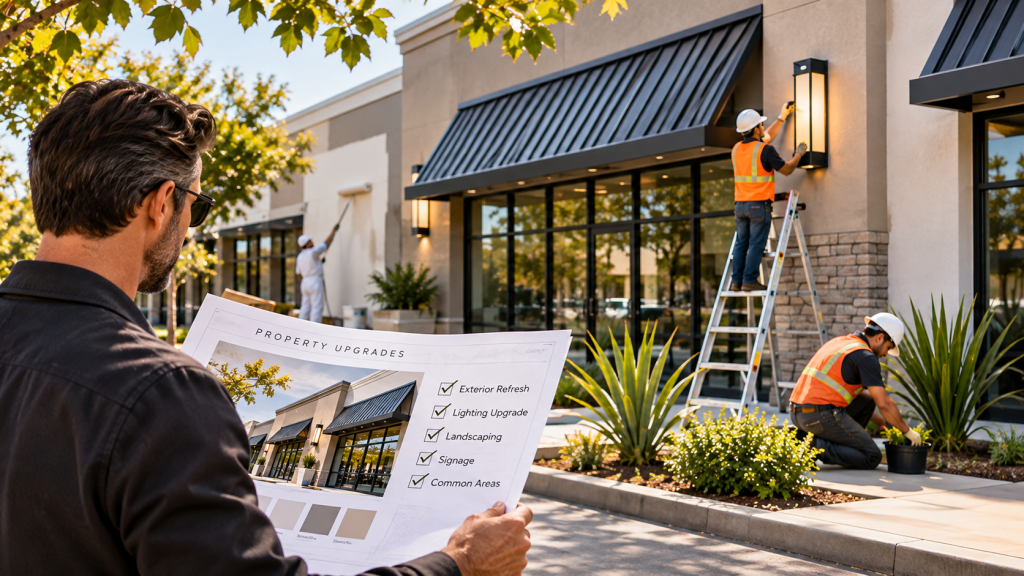
Not every property improvement needs to be a major renovation.
Sometimes, relatively modest upgrades can make a building more appealing to tenants and their customers.
Think about the commercial properties you visit regularly.
What makes one shopping center feel more inviting than another?
It might be the landscaping.
The lighting.
The signage.
The condition of the parking lot.
Or simply how well the property is maintained.
These details influence the experience of people using the property.
Focus on Improvements That Matter
Depending on the building, owners might consider:
- Refreshing exterior paint
- Improving landscaping
- Upgrading exterior lighting
- Repairing parking lots and walkways
- Updating common areas
- Improving signage and wayfinding
- Modernizing building entrances
- Upgrading inefficient building systems
These improvements can support a property’s marketability, functionality, and tenant satisfaction.
Consider the Tenant’s Perspective
Imagine you’re choosing between two comparable office buildings.
Both have similar rental rates.
Both are in convenient locations.
But one has clean common areas, attractive landscaping, updated lighting, and a well-maintained exterior.
The other looks tired and neglected.
Which would you feel more comfortable bringing clients into?
For many businesses, their location is part of their professional image.
A well-maintained property can help tenants feel confident about where they operate.
Not Every Improvement Pays for Itself
Before spending money, ask:
Will this improvement help attract tenants?
Could it support competitive rental rates?
Will it reduce future maintenance costs?
Does it address an actual property problem?
Is it appropriate for the types of businesses likely to occupy the space?
A $15,000 improvement that solves a recurring problem or helps make a vacant space more marketable may be more useful than an expensive cosmetic renovation with little practical benefit.
The smartest improvements are the ones that support the property’s actual needs and long-term leasing strategy.
3. Reduce Operating Expenses Without Sacrificing Quality
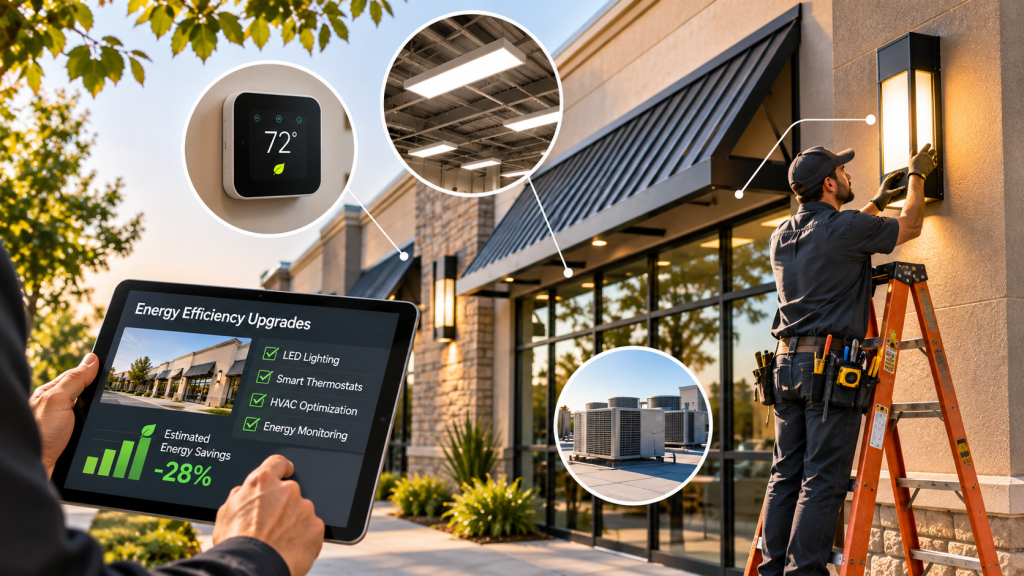
Increasing income is one way to improve property performance.
Reducing unnecessary expenses is another.
This is where proactive property management can make a meaningful difference.
Commercial properties have ongoing costs, including insurance, utilities, maintenance, landscaping, repairs, and management.
While some expenses are unavoidable, others may offer opportunities for improvement.
Look for Operational Efficiencies
For example:
Energy efficiency: Could updated LED lighting, lighting controls, or properly maintained HVAC equipment reduce utility costs?
Preventive maintenance: Could regular servicing help identify small problems before they become expensive repairs?
Vendor contracts: Are landscaping, cleaning, and other service contracts competitively priced and delivering the expected quality?
Water usage: Could irrigation adjustments or drought-tolerant landscaping reduce water consumption?
Insurance: Are coverage and premiums being reviewed periodically with a qualified insurance professional?
The goal isn’t to cut every expense.
It’s to spend money more effectively.
A Simple Financial Example
Imagine a commercial property generates $250,000 in annual operating income.
Its annual operating expenses total $75,000.
That produces:
$175,000 in NOI.
Now suppose the owner identifies $10,000 in sustainable annual savings without reducing services or creating additional maintenance risk.
The property’s NOI could increase to:
$185,000 annually.
At a hypothetical 6.5% capitalization rate, that additional $10,000 of annual NOI would represent approximately:
$153,846 in additional indicated value.
However, the actual benefit depends on the property’s lease structure.
For example, if tenants reimburse operating expenses under NNN leases, reducing expenses may also reduce reimbursements. The savings may benefit tenants rather than increasing the owner’s NOI dollar for dollar.
That’s why owners should evaluate the full financial picture rather than looking at individual expenses in isolation.
Why Preventive Maintenance Matters
Sometimes the best way to save money is to spend a little before a problem becomes serious.
Regular roof inspections, HVAC servicing, drainage maintenance, and routine building checks can help identify developing issues.
Preventive maintenance doesn’t eliminate unexpected expenses, but it can help owners plan more effectively and reduce avoidable disruptions.
Good property management isn’t simply about controlling expenses. It’s about protecting the property’s performance over time.
4. Improve Tenant Retention and Leasing Strategy
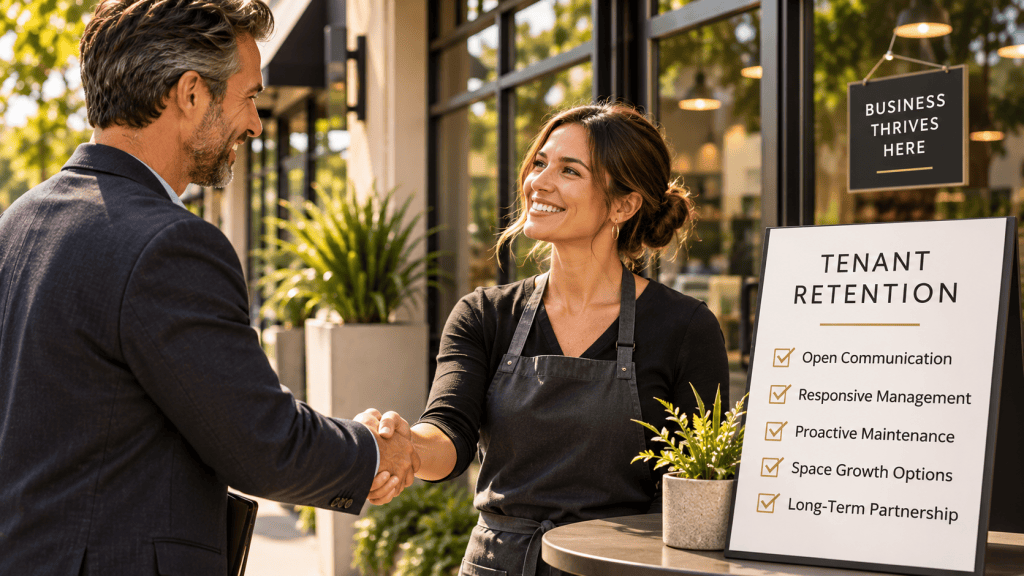
One of the most valuable assets a commercial property can have is a strong, stable tenant base.
When a tenant is operating successfully and paying rent consistently, that stability can support predictable property income.
And when tenants stay longer, owners may avoid some of the costs associated with finding replacements.
Why Tenant Retention Matters
When a tenant moves out, an owner may face:
- Lost rental income
- Turnover repairs
- Marketing expenses
- Leasing commissions
- Tenant improvement costs
- Free-rent concessions
- Ongoing property carrying costs
That’s why maintaining positive tenant relationships can be financially valuable.
What Can Owners Do?
Start with communication.
Are tenants satisfied with the property?
Are maintenance requests being handled promptly?
Do they have concerns about parking, access, signage, or common areas?
Are their businesses growing?
Might they need additional space in the future?
Understanding tenant needs can help owners plan.
Plan Ahead for Lease Expirations
Commercial property owners should maintain an accurate schedule of lease expiration dates, renewal options, and notice deadlines.
If a lease expires in nine months, that may be a good time to begin evaluating the market and preparing for discussions, depending on the lease and tenant.
Waiting until the tenant has already moved out can limit your options.
Think About the Tenant Mix
For shopping centers and multi-tenant properties, the mix of businesses can also matter.
Imagine a neighborhood center with a coffee shop, fitness studio, professional services business, and restaurant.
Each tenant may attract customers at different times and for different reasons.
That variety can create a more useful and appealing destination.
Of course, the ideal tenant mix depends on the property, zoning, parking, operating hours, and local demand.
A successful leasing strategy is about more than filling spaces. It’s about attracting tenants who fit the property and support its long-term performance.
5. Identify Underused Space and New Income Opportunities
This is one of the more interesting ways owners can potentially create value.
Sometimes a commercial property has areas that aren’t being used to their full potential.
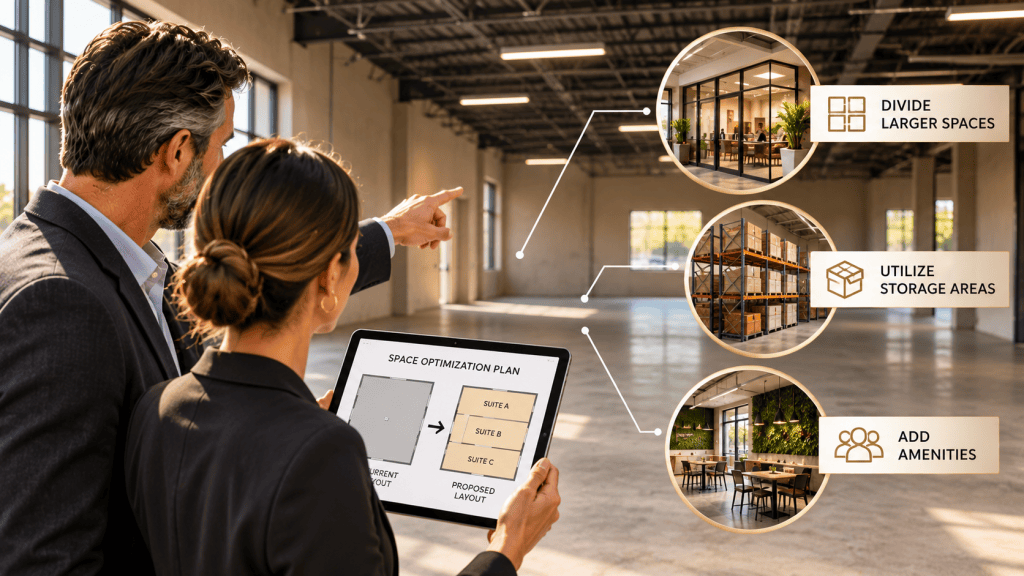
That could include an oversized suite, an underutilized storage area, or space that might function better with a different layout.
The key is identifying opportunities that are practical, financially worthwhile, and legally permissible.
Look at How the Property Is Being Used
Consider a commercial building with a 5,000-square-foot suite.
What if the market has stronger demand for smaller suites?
Could the space be divided into two separate units?
Would that make the property more attractive to a wider group of tenants?
Possibly.
But dividing a commercial suite can involve significant costs, including construction, utility modifications, fire and life-safety requirements, accessibility improvements, and permitting.
It should be evaluated carefully before proceeding.
Other Opportunities to Explore
Depending on the property, owners might consider:
- Reconfiguring oversized suites
- Improving the functionality of unused storage areas
- Evaluating permitted signage opportunities
- Adding approved amenities that tenants value
- Repositioning space for a different permitted use
- Improving parking or circulation layouts
- Exploring permitted additional uses or development potential
Some properties may also support new income sources, but those opportunities should be verified against zoning, lease restrictions, easements, permits, and market demand.
Think About the Property’s Highest and Best Use
A building that worked well for a previous tenant may not be ideally configured for today’s market.
For example, a highly specialized retail layout might appeal to a limited number of businesses.
A more flexible configuration could potentially broaden the tenant pool.
But the cost of conversion must make financial sense.
Ask the Right Questions
What types of businesses are looking for space in this area?
Does the current layout meet their needs?
Would a modification create more usable or leasable space?
What would the improvement cost?
How much additional income might it generate?
How long would it take to recover the investment?
Creating value often starts with recognizing possibilities that aren’t immediately obvious.
How These Improvements Can Affect Property Value
Let’s bring the concepts together.
Commercial investment properties are often evaluated in part using their income.
One simplified valuation relationship is:
Property Value = Net Operating Income ÷ Capitalization Rate
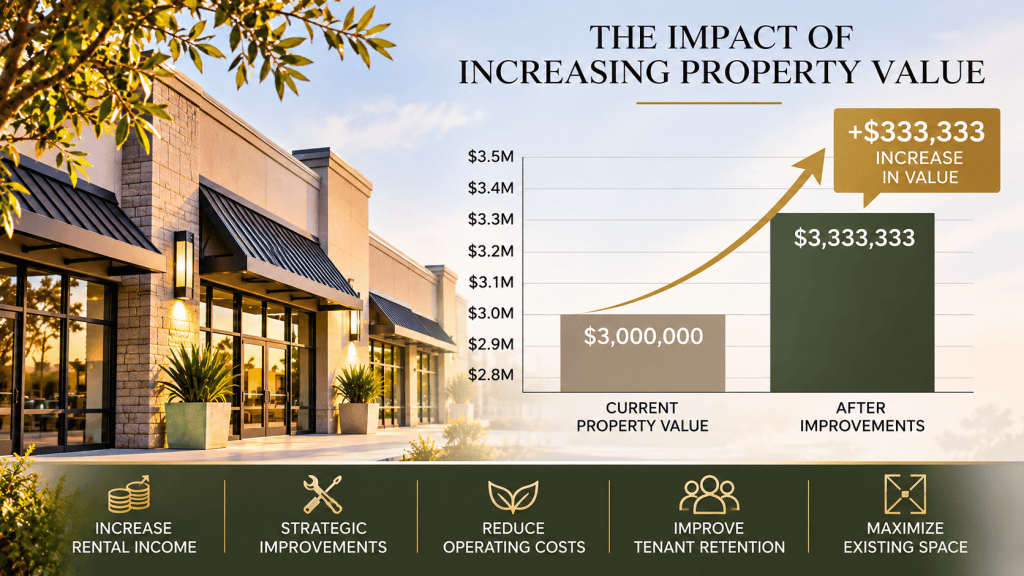
Imagine a commercial property currently generates $180,000 in annual NOI.
At a hypothetical 6% cap rate, its indicated value would be:
$180,000 ÷ 0.06 = $3,000,000
Now imagine the owner implements several improvements over time.
Through sustainable rental growth, better expense management, and improved operations, the property’s NOI increases to $200,000 annually.
At the same hypothetical 6% cap rate:
$200,000 ÷ 0.06 = approximately $3,333,333
That’s a difference of approximately:
$333,333 in indicated value.
| Financial Metric | Before | After |
|---|---|---|
| Annual NOI | $180,000 | $200,000 |
| Assumed Cap Rate | 6.0% | 6.0% |
| Indicated Value | $3,000,000 | $3,333,333 |
| Difference | — | +$333,333 |
This example assumes the cap rate remains unchanged and the additional NOI is sustainable.
It doesn’t account for improvement costs, leasing expenses, changes in market conditions, or other valuation considerations.
Actual property value may increase by more or less than the illustration suggests—or may not increase at all.
Still, the example demonstrates why investors pay attention to NOI.
Improving a property’s operating performance can be one way to create value without purchasing additional real estate.
Where Should Property Owners Start?
If you own commercial property in San Luis Obispo County, you don’t necessarily need to begin with a major renovation or complicated investment strategy.
Start by reviewing what you already have.
Step 1: Review Your Current Income
Look at your rent roll, lease terms, and scheduled increases.
Compare current rental rates with relevant market data.
Identify upcoming lease expirations and opportunities for negotiated renewals.
Step 2: Review Operating Expenses
Examine actual expenses over the past year or several years.
Look for unusual increases, recurring repairs, or services that could be managed more efficiently.
Account for tenant reimbursements before assuming savings will increase NOI.
Step 3: Walk the Property
Evaluate the property as if you were a prospective tenant.
How does it look?
Is the signage clear?
Are the parking areas and common spaces well maintained?
Are there improvements that would make the building more functional or appealing?
Step 4: Talk With Your Tenants
Understand how the property is working for the businesses occupying it.
Address legitimate concerns.
Learn about potential expansion, renewal, or relocation plans.
Step 5: Develop a Long-Term Plan
Prioritize improvements based on expected benefits, costs, and timing.
Some changes may be inexpensive.
Others may require a capital budget or professional evaluation.
The goal is to develop a plan that supports the property’s long-term performance rather than making changes simply for the sake of making them.
Final Thoughts: Sometimes the Best Opportunity Is Already Yours
Commercial real estate investing isn’t always about finding the next building to purchase.
Sometimes it’s about looking at an existing property with fresh eyes.
Could rental income be improved over time?
Could better maintenance reduce unnecessary costs?
Could thoughtful upgrades make the property more attractive?
Could stronger tenant relationships help maintain occupancy?
Could underused space serve a more valuable purpose?
These questions can reveal opportunities that might otherwise go unnoticed.
And while not every improvement will increase property value, a thoughtful strategy can help owners make better decisions about where to invest their time and capital.
The most successful property owners don’t just focus on what their buildings are worth today. They think about what those buildings could become tomorrow.
Want to Explore Your Commercial Property’s Potential?
At Trujillo Commercial Real Estate Group, we work with commercial property owners, investors, and businesses throughout San Luis Obispo County.
From commercial leasing and sales to property management, our team helps clients evaluate their properties and identify opportunities to support long-term performance.
Whether you’re reviewing rental rates, considering property improvements, or planning for future lease expirations, understanding your property’s current position is the first step.
Contact Rod Trujillo to discuss your commercial property.
Rod Trujillo
Trujillo Commercial Real Estate Group
Phone: 805-439-4733
Email: rod@trujillo-group.com
Website: www.trujillo-group.com
Disclaimer: This article is intended for general educational purposes and does not constitute legal, tax, financial, appraisal, or investment advice. Financial examples are hypothetical. Actual property performance and value depend on lease terms, market conditions, operating expenses, capital expenditures, and other factors. Property owners should consult qualified professionals when making property and investment decisions.